


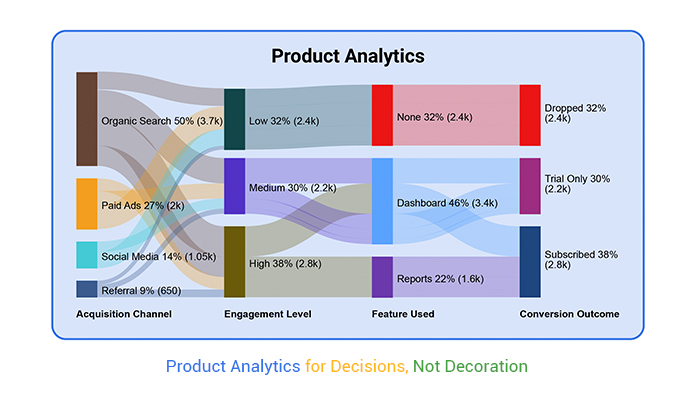
Product Analytics: A Data-Driven Approach to Sustainable Product Growth
1. Platform Category: Product Analytics Platform, Event Analytics Tool, Customer Behavior Analytics
2. Core Technology/Architecture: Event-driven tracking, SaaS, Real-time data processing, Behavioral analytics engine
3. Key Data Governance Feature: Event schema management, Data quality validation, Role-based access control, Data privacy controls
4. Primary AI/ML Integration: Anomaly detection, Predictive analytics (e.g., churn, conversion), Smart segmentation, A/B test optimization
5. Main Competitors/Alternatives: Amplitude, Mixpanel, Heap, Pendo, Google Analytics 4, Adobe Analytics
Product Analytics: A Data-Driven Approach to Product Growth empowers businesses to truly understand how users interact with their offerings. It moves beyond guesswork, providing a clear lens into user behavior, feature adoption, and retention. By meticulously analyzing these interactions, organizations gain actionable insights to refine their products and foster sustainable expansion in a competitive digital landscape. This strategic approach ensures that every product decision is rooted in empirical evidence, leading to more impactful innovations and a stronger connection with the target audience.
Introduction to the Power of Product Analytics
In today’s fast-evolving digital economy, success hinges on more than just building a great product; it requires a profound understanding of how users engage with it. This is precisely where Product Analytics emerges as an indispensable discipline. Moving beyond traditional web analytics that might focus on page views or traffic sources, product analytics delves deep into the “why” and “how” of user interaction within a specific product environment. It’s about dissecting the entire user journey, from initial onboarding and feature discovery to repeated usage and eventual churn, transforming raw data into strategic intelligence.
The objective of this deep dive is to explore the multifaceted world of product analytics, dissecting its core components, highlighting its transformative business value, and contrasting it with conventional data approaches. We will also address the inherent challenges in its adoption and offer World2Data’s expert perspective on its future trajectory. For any organization striving for continuous improvement and sustainable growth, embracing product analytics is no longer an option but a strategic imperative.
Core Breakdown: Unpacking the Foundation of Product Insights
At its heart, product analytics relies on a sophisticated infrastructure designed to capture, process, and interpret user interactions at a granular level. Unlike traditional analytics, which might aggregate data, product analytics thrives on event-level tracking, where every click, swipe, view, and interaction is recorded as a discrete event. This foundation supports a robust system capable of delivering profound behavioral insights.
Defining Product Analytics: Beyond Surface-Level Metrics
Product Analytics involves the systematic collection, tracking, and analysis of data related to how users engage with a digital product. This encompasses a vast array of data points, including but not limited to: user demographics, device types, session durations, feature usage frequency, navigation paths, conversion events, error rates, and retention cohorts. The goal is to move past superficial metrics to understand the underlying motivations and friction points within the user experience.
It’s not just about knowing what happened, but why it happened. For instance, knowing that a feature has low adoption is one thing; product analytics helps uncover whether it’s due to poor discoverability, usability issues, or a lack of perceived value. By correlating various event streams, product teams can construct detailed user journey maps, identify common pain points, and pinpoint moments of delight. This granular understanding allows for a proactive rather than reactive approach to product development.
Key Components and Architecture of a Modern Product Analytics Platform
A cutting-edge product analytics platform typically integrates several critical components to deliver its powerful capabilities:
- Event-Driven Tracking: This is the bedrock. Every user action is logged as an event with associated properties (e.g., “button_clicked” with properties like “button_name”, “page_url”, “user_id”). This granular data forms the basis for all subsequent analysis, allowing for incredible flexibility in querying and segmenting user behavior.
- Data Ingestion and Processing: Robust pipelines are needed to handle massive volumes of real-time and historical event data, ensuring accuracy and minimal latency. This often involves scalable cloud-native architectures, stream processing technologies like Apache Kafka or Kinesis, and distributed data storage solutions, capable of processing billions of events daily.
- Behavioral Analytics Engine: This engine processes the raw event data to derive meaningful behavioral patterns. It enables sophisticated queries, funnel analysis (tracking users through multi-step processes), cohort analysis (grouping users by shared characteristics or events over time), and advanced segmentation based on any recorded event or user property.
- Feature Store (for AI/ML Integration): While more common in pure MLOps platforms, the concept of a “feature store” is increasingly relevant in advanced product analytics. It allows product teams and data scientists to define, compute, and share features (e.g., “user_has_logged_in_last_7_days”, “average_session_duration”, “number_of_items_in_cart”) consistently across various analytical models, including those powering AI-driven insights within the analytics platform, ensuring reusability and consistency.
- Data Labeling and Annotation (for AI/ML): For platforms leveraging AI/ML, especially in areas like anomaly detection, predictive modeling for churn, or smart segmentation, the ability to label specific user behaviors or outcomes (e.g., “successful conversion”, “churn risk”, “feature requested”) is crucial for training and validating supervised and unsupervised models effectively.
- Segmentation and Cohorting Tools: These allow users to group customers based on shared attributes (e.g., geography, subscription tier) or behaviors (e.g., “users who completed onboarding but didn’t use Feature X”). This enables targeted analysis, A/B testing, and personalized product experiences.
- Visualization and Reporting Dashboards: User-friendly interfaces are essential for product managers and designers to easily explore data, build custom reports, and monitor key performance indicators (KPIs) without needing deep technical expertise. These dashboards often support drag-and-drop functionality and templated reports for common product analytics use cases.
- A/B Testing and Experimentation Frameworks: Integrated tools to design, run, and analyze experiments help product teams validate hypotheses about new features or changes scientifically. These frameworks typically include statistical significance calculations, variant management, and robust reporting to measure the true impact of changes.
Challenges and Barriers to Adoption
Despite its undeniable benefits, implementing and maximizing Product Analytics presents several challenges that organizations must navigate:
- Data Quality and Integrity: The adage “garbage in, garbage out” applies directly. Poorly defined event schemas, inconsistent tracking across different platforms or versions, or incomplete data can lead to misleading insights and erode trust in the data. Maintaining clean, accurate data requires diligent event schema management, robust data quality validation rules, and continuous monitoring.
- Complexity of Implementation: Setting up comprehensive event tracking across multiple product surfaces (web, iOS, Android, backend services) can be technically complex and resource-intensive, requiring careful planning, strong engineering expertise, and ongoing maintenance.
- Data Overload and Interpretation: The sheer volume and granularity of data generated can be overwhelming. Without clear objectives, well-defined hypotheses, and skilled analysts who understand both the data and the product, teams can drown in data without extracting meaningful, actionable insights.
- Integrating with Existing Systems: Product analytics data often needs to be integrated with CRM, marketing automation, customer support systems, or a central data warehouse to provide a holistic customer view. This integration can be technically challenging due to disparate data formats, APIs, and data silos across different departments.
- Privacy and Compliance: With increasing data privacy regulations (e.g., GDPR, CCPA, CCPA), ensuring data collection practices are compliant and user privacy is protected (e.g., anonymization, pseudonymization, consent management, opt-out mechanisms) adds another layer of complexity and requires a strong legal and technical framework.
- Skill Gap: Extracting maximum value from a product analytics platform requires a blend of analytical skills, product sense, statistical understanding, and often some technical proficiency. Building or acquiring this diverse skill set within product teams can be a significant hurdle.
- Resistance to Data-Driven Culture: Shifting from intuition-based decisions to data-driven ones can meet internal resistance if stakeholders are not aligned, educated on the benefits, or lack trust in the data. Fostering a truly data-centric culture requires strong leadership and continuous evangelization.
Business Value and ROI of Product Analytics
The return on investment (ROI) from a well-implemented product analytics strategy is substantial and far-reaching, fundamentally transforming how products are built and iterated:
- Enhanced User Experience: By identifying friction points, bottlenecks, and areas of confusion within user flows, product teams can iteratively refine the user interface and experience, leading to more intuitive, delightful, and satisfying interactions. This directly translates to higher user engagement, reduced support costs, and increased customer loyalty.
- Optimized Feature Development and Prioritization: Data-backed insights ensure that new features address genuine user needs and pain points, preventing wasted development cycles on features users don’t want or won’t use. This allows for evidence-based prioritization, ensuring engineering resources are allocated to initiatives with the highest potential impact and value, maximizing development efficiency.
- Faster Model Deployment and Iteration: For product teams leveraging AI/ML (e.g., for recommendation engines, personalized experiences, smart search), robust product analytics provides the necessary training data, validation datasets, and crucial feedback loops to accelerate model development, deployment, and continuous improvement. This agile approach minimizes time-to-market for new AI-powered features and ensures they are effective.
- Improved Data Quality for AI: A disciplined approach to product analytics inherently improves the quality, consistency, and completeness of event data. This high-quality, relevant data is paramount for training accurate, unbiased, and performant AI/ML models that drive intelligent product features, automate insights, and inform strategic decisions.
- Increased User Retention and Reduced Churn: Product analytics enables teams to understand the root causes of churn, identify at-risk users based on their behavior patterns, and proactively implement targeted re-engagement strategies, significantly boosting long-term customer retention rates and customer lifetime value (CLTV).
- Higher Conversion Rates: By analyzing conversion funnels (e.g., from trial to paid, or from viewing an item to purchasing), teams can pinpoint exact drop-off points, test hypotheses for improvement, and optimize user flows to increase successful conversions for key actions, whether it’s sign-ups, subscriptions, or feature adoption.
- Competitive Advantage: Organizations that deeply understand their users, can quickly adapt their products based on data, and personalize experiences gain a significant competitive edge over rivals relying on guesswork, slower feedback loops, or generic market research. This agility allows for rapid response to market changes and user demands.
- Effective Resource Allocation: By providing clarity on what works, what doesn’t, and where user value truly lies, product analytics helps allocate development, marketing, and customer support resources more effectively, maximizing impact per dollar spent and streamlining overall business operations.
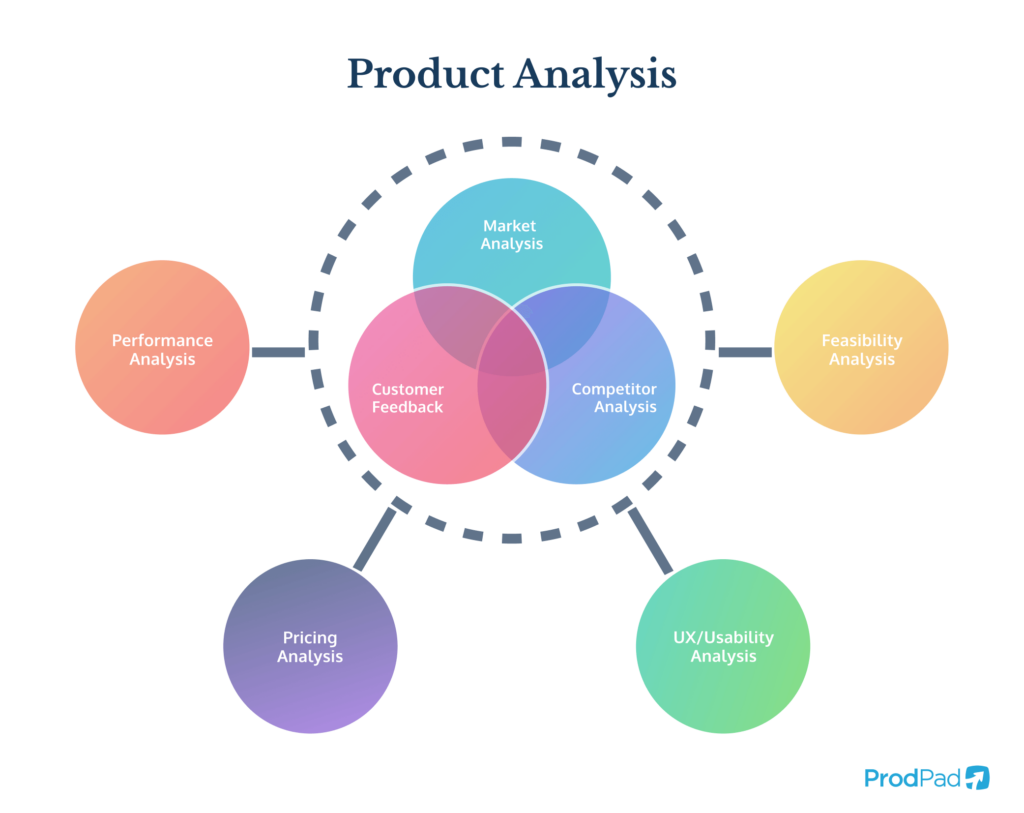
Comparative Insight: Product Analytics vs. Traditional Data Approaches
To truly appreciate the distinct value of product analytics, it’s beneficial to compare it with more traditional data management and analysis paradigms, such as generic web analytics, enterprise data lakes, and data warehouses. While these systems all handle data, their focus, granularity, ultimate purpose, and target users diverge significantly, highlighting why a specialized product analytics solution is often necessary.
Product Analytics vs. Traditional Web Analytics (e.g., Google Analytics 4)
- Focus and Purpose:
- Traditional Web Analytics: Primarily focuses on traffic acquisition, marketing campaign performance, overall website or application usage (page views, sessions), and broad audience demographics. It’s often geared towards marketing teams to understand how users arrive at a digital property and their general engagement.
- Product Analytics: Deeply rooted in understanding specific user behavior within the product’s interface and features. Its focus is on feature adoption, user flows through specific product journeys, retention of users over time, conversion funnels for in-product actions, and identifying product-specific pain points and opportunities. It’s built for product managers, designers, and growth teams to optimize the product itself.
- Data Granularity and Definition:
- Traditional Web Analytics: While modern versions like GA4 are more event-driven than their predecessors, they still often present data in aggregated forms or focus on broader metrics suitable for marketing attribution. The event definition might be less tailored to specific, granular product interactions (e.g., “clicked ‘add to cart'” vs. “clicked ‘add to cart’ on product ID 123 from category ‘electronics'”).
- Product Analytics: Emphasizes highly granular, custom event-level data capture where every interaction, even micro-interactions, can be tracked with rich properties. This allows for highly detailed behavioral segmentation, precise user journey mapping, and a deeper understanding of user intent.
- Actionability:
- Traditional Web Analytics: Insights often lead to marketing adjustments (e.g., optimizing ad spend, SEO strategy, content marketing).
- Product Analytics: Insights directly inform product development decisions, UI/UX changes, feature prioritization, in-product messaging, and personalized user experiences, leading to direct product improvements.
Product Analytics vs. Data Lakes/Data Warehouses
- Purpose and User Base:
- Data Lakes/Warehouses: Serve as central, often enterprise-wide, repositories for all organizational data, supporting a wide range of analytics, business intelligence (BI), and reporting needs across various departments (finance, operations, sales, HR, etc.). They are typically managed by specialized data engineering and BI teams.
- Product Analytics Platforms: Are specialized tools built specifically for product teams. While they might pull data from or push data to a central data warehouse for a holistic view, their core functionality is tailored for behavioral analysis and product optimization, providing self-serve access and intuitive interfaces for non-technical product roles.
- Data Structure and Processing:
- Data Lakes: Store raw, unstructured or semi-structured data (logs, sensor data, social media feeds) without a predefined schema (schema-on-read), offering immense flexibility but requiring significant processing and expertise for analysis.
- Data Warehouses: Store structured, cleaned, and transformed data (schema-on-write), optimized for reporting and complex SQL queries, providing a single source of truth for structured data. Data is typically ETL’d (Extract, Transform, Load) into a predefined dimensional schema.
- Product Analytics: Often leverage event-driven schemas that are specifically designed to capture user interactions. While the raw event data might eventually land in a data lake or warehouse for long-term storage or complex joins, the real-time processing and immediate analysis capabilities within the product analytics platform are highly optimized for speed, intuitive exploration, and product-centric insights using specialized behavioral analytics engines distinct from standard SQL query engines.
- Speed to Insight:
- Data Lakes/Warehouses: Can require significant effort (data engineering setup, complex SQL queries, BI dashboard development) to generate specific insights, potentially leading to longer feedback loops for product teams due to dependency on technical roles.
- Product Analytics: Designed for rapid experimentation and iteration. Its intuitive interfaces, visual builders, and pre-built analysis types (funnels, cohorts, retention charts) allow product managers and designers to get answers to critical questions about user behavior within minutes or hours, enabling an agile product development process.
In essence, while data lakes and data warehouses provide the foundational, enterprise-wide data infrastructure, product analytics platforms act as specialized “last-mile” solutions that translate raw behavioral data into actionable, product-specific intelligence, empowering product teams directly and efficiently to build better products faster.
World2Data Verdict: The Indispensable Compass for Product Innovation
At World2Data, we unequivocally believe that Product Analytics is no longer a luxury but an indispensable strategic asset for any organization striving for sustained growth and innovation in the digital age. The era of guesswork in product development is over; success now demands a continuous, data-driven dialogue with your users. The future of product success will be owned by those who can not only collect vast amounts of user interaction data but also translate it rapidly into actionable insights that fuel iterative improvements and truly delightful user experiences. We project an increasing convergence of product analytics platforms with advanced AI/ML capabilities, offering predictive insights into user behavior, proactive anomaly detection, and automated optimization of user flows. Organizations must prioritize robust data governance and event schema management from day one, fostering a culture where data quality is paramount. Investing in product analytics capabilities and the talent to wield them effectively will be the defining factor for market leaders in the coming decade, making it the essential compass guiding product teams toward truly impactful innovation.