

Churn Analysis: Why Customers Leave and How to Prevent It
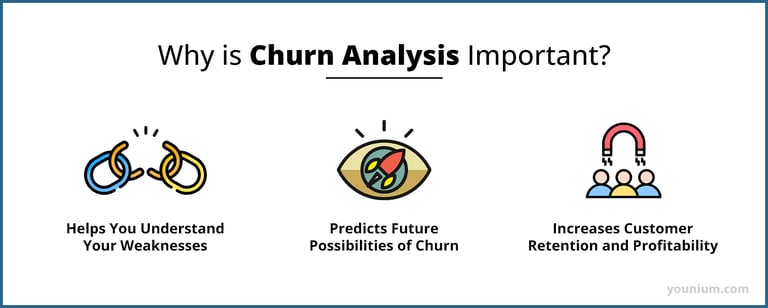
In today’s competitive landscape, understanding customer behavior is paramount for sustainable business growth. Churn Analysis provides a critical lens into why customers disengage, offering invaluable insights for proactive retention strategies. It’s not just about counting lost customers, but rather deciphering the underlying patterns and triggers that lead to their departure. By mastering Churn Analysis, businesses can transform potential losses into opportunities for deeper customer loyalty and enhanced profitability.
Understanding Churn Analysis: The Core of Customer Retention
Customer churn, often simply referred to as customer attrition, is the rate at which customers stop doing business with a company over a given period. This metric serves as a crucial barometer for customer satisfaction, product relevance, and overall business health. A high churn rate signals underlying issues that can erode revenue, inflate customer acquisition costs, and ultimately stifle sustainable growth. It’s an undisputed fact in business economics that retaining an existing customer is significantly more cost-effective than acquiring a new one, making robust Churn Analysis a cornerstone of any successful customer-centric strategy.
The objective of effective Churn Analysis extends beyond merely identifying who has left. It aims to:
- Predict Future Churn: Leverage historical data to forecast which customers are most likely to churn in the near future.
- Identify Root Causes: Pinpoint the specific reasons, events, or changes in behavior that precede customer departure.
- Segment At-Risk Customers: Group customers by their churn probability and specific contributing factors, allowing for targeted interventions.
- Optimize Retention Strategies: Develop and implement personalized, timely actions designed to prevent churn before it happens.
Core Breakdown: The Technical and Architectural Foundations of Churn Analysis
Modern Churn Analysis platforms are sophisticated ecosystems built on advanced data technologies and machine learning. These platforms integrate seamlessly across various enterprise systems, pulling data from diverse sources to create a holistic view of the customer journey.
Data Foundations and Technological Architecture
At the heart of any effective Churn Analysis system lies a robust data infrastructure. This typically involves:
- Data Warehousing/Data Lakes: Essential for storing vast quantities of historical customer data, encompassing everything from transaction records and service interactions to website clicks and application usage. Data lakes provide the flexibility for raw, unstructured data, while data warehouses offer structured, curated data for analytical queries.
- Real-time Data Processing: Critical for capturing immediate customer interactions and behavioral shifts. Technologies like Kafka or Apache Flink enable businesses to detect anomalies or changes in engagement patterns as they happen, facilitating timely interventions.
- Customer Segmentation: Beyond basic demographic segmentation, advanced platforms utilize clustering algorithms to group customers based on their behavioral patterns, value, and likelihood to churn. This allows for highly targeted retention campaigns.
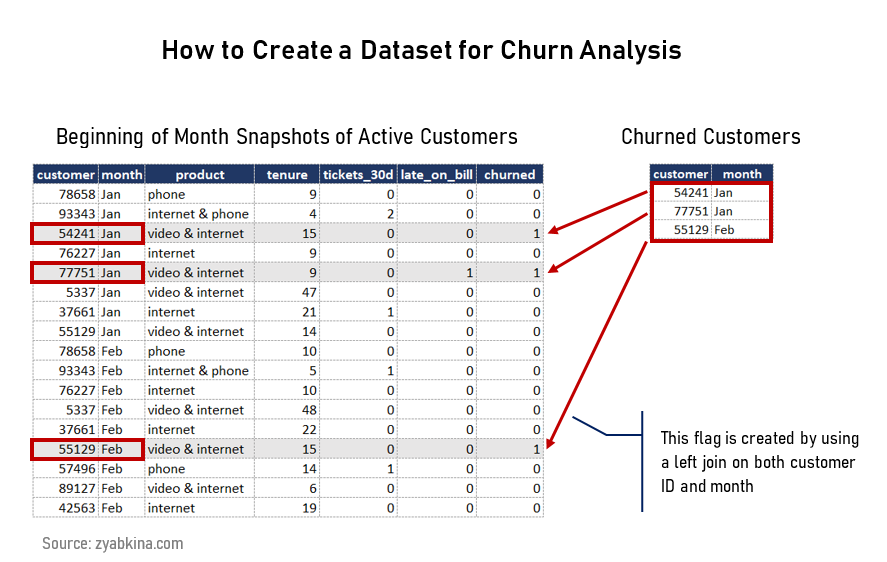
- Feature Engineering: This is the process of transforming raw data into features that better represent the underlying problems to predictive models. For churn, features might include “days since last login,” “average spending over the last 3 months,” “number of support tickets,” or “product usage frequency.”
AI/ML Powering Prediction and Prevention
The true power of modern Churn Analysis comes from its integration of artificial intelligence and machine learning:
- Predictive Churn Models: These are the core of proactive churn prevention. Common algorithms include:
- Logistic Regression: A foundational statistical model often used for binary classification (churn/no churn).
- Decision Trees and Random Forests: Excellent for interpreting complex interactions between features and identifying key churn drivers.
- Gradient Boosting Machines (e.g., XGBoost, LightGBM): Highly powerful and accurate models that excel in handling complex datasets and achieving superior predictive performance.
- Neural Networks: Can uncover intricate non-linear relationships in very large datasets, especially useful with rich behavioral data.
- Anomaly Detection: Machine learning models can identify unusual customer behaviors that deviate from established norms, such as a sudden drop in engagement or a change in usage patterns, which often precede churn.
- Reinforcement Learning for Personalized Interventions: More advanced systems can use reinforcement learning to dynamically learn the most effective intervention strategies for different customer segments, optimizing offers or communications in real-time based on their likelihood to respond positively and stay.
- Natural Language Processing (NLP) for Sentiment Analysis: By analyzing customer feedback from surveys, social media, support tickets, and chat logs, NLP can gauge customer sentiment, identify pain points, and uncover early warning signs of dissatisfaction that traditional quantitative metrics might miss.
Challenges and Data Governance in Churn Analysis
While immensely powerful, implementing effective Churn Analysis presents several challenges, particularly concerning data quality, privacy, and operational complexity:
- Data Quality Management: Inaccurate, incomplete, or inconsistent data can severely compromise the reliability of churn predictions. Robust data validation, cleansing, and enrichment processes are essential.
- Data Drift: Customer behavior, market conditions, and product offerings are constantly evolving. Churn models trained on past data can become less accurate over time (model drift or data drift), necessitating continuous monitoring, retraining, and recalibration.
- MLOps Complexity: Operationalizing machine learning models for churn prediction requires sophisticated MLOps (Machine Learning Operations) pipelines for model deployment, monitoring, versioning, and retraining, which can be technically challenging.
- Data Anonymization/Pseudonymization: Handling sensitive customer data for churn analysis requires strict adherence to privacy regulations (e.g., GDPR, CCPA). Techniques like anonymization and pseudonymization are critical to protect customer identities while enabling analysis.
- Role-Based Access Control (RBAC): Ensuring that only authorized personnel can access sensitive customer data, especially when predictive models might reveal individual churn risk, is a key security and compliance requirement.
- Data Lineage: Understanding the origin, transformations, and usage of data is vital for trust, compliance, and debugging models. A clear data lineage helps track how customer attributes flow through the analysis pipeline.
- Data Catalog for Customer Attributes: A comprehensive data catalog helps data scientists and analysts discover, understand, and reuse customer-related datasets and features efficiently, preventing data silos and improving model development.
Business Value and ROI of Robust Churn Analysis
The investment in sophisticated Churn Analysis platforms yields significant returns:
- Faster Model Deployment: Integrated platforms streamline the entire machine learning lifecycle, from data ingestion to model deployment, leading to quicker insights and shorter time-to-value for retention campaigns.
- Improved Data Quality for AI: By emphasizing data governance and quality, these platforms ensure that the data feeding AI models is reliable, leading to more accurate predictions and effective interventions.
- Maximizing Customer Lifetime Value (CLTV): By successfully retaining customers, businesses extend their relationship, increasing their total spend and contributing significantly to long-term revenue.
- Reduced Customer Acquisition Costs (CAC): Investing in retention is often a fraction of the cost of acquiring new customers, making churn prevention a highly efficient use of marketing and operational budgets.
- Enhanced Customer Satisfaction and Loyalty: Proactive intervention based on churn analysis not only prevents departure but also demonstrates a company’s commitment to its customers, fostering stronger relationships and advocacy.
- Sustained Business Profitability: A stable customer base with reduced churn ensures more predictable revenue streams and contributes directly to a healthier, more profitable bottom line.
Comparative Insight: Modern Churn Analysis vs. Traditional Approaches
The landscape of Churn Analysis has evolved dramatically from its rudimentary beginnings. Historically, businesses relied on simpler methods, often confined to basic spreadsheet calculations or reactive reporting from traditional Business Intelligence (BI) platforms. These methods typically focused on lagging indicators – analyzing churn rates after customers had already left – and offered limited predictive capabilities.
Traditional Data Lake/Data Warehouse Approach for Churn (Without AI/ML Focus): While data lakes and data warehouses have long served as repositories for customer data, their traditional use for churn analysis often involved:
- Manual querying and report generation by data analysts.
- Basic segmentation based on demographics or simple transactional data.
- Reactive analysis of churned customer characteristics, rather than proactive prediction.
- Limited ability to integrate real-time behavioral data or unstructured feedback.
- High dependency on human expertise for pattern recognition, making scalability difficult.
Modern Churn Analysis Platforms: In stark contrast, today’s dedicated Churn Analysis platforms, categorized under CRM Analytics, Data Science Platforms, and Marketing Automation Platforms, represent a paradigm shift. They are purpose-built to leverage advanced analytics and machine learning, offering:
- Proactive Prediction: Utilizing predictive churn models to identify at-risk customers *before* they churn, enabling timely intervention.
- Real-time Insights: Integrating real-time data streams to detect immediate shifts in customer behavior.
- Automated Segmentation & Personalization: Dynamically segmenting customers and tailoring retention offers using AI-driven insights.
- Comprehensive Data Integration: Seamlessly combining structured transactional data with unstructured behavioral and sentiment data from diverse sources.
- Scalability & Automation: MLOps frameworks automate model training, deployment, and monitoring, ensuring models remain accurate and relevant at scale.
- Advanced Feature Engineering: Automating the creation of powerful predictive features from raw data, reducing manual effort and improving model performance.
Main competitors and alternatives in this space include integrated platforms like Salesforce Einstein, which embeds AI directly into CRM workflows; Adobe Experience Platform, offering comprehensive customer data management and personalization capabilities; SAP Customer Data Platform; and Pega Customer Decision Hub, known for its real-time customer engagement and AI-powered decisioning. Beyond these enterprise solutions, many organizations also opt for Custom Data Science Solutions, leveraging open-source Python/R libraries (e.g., scikit-learn, TensorFlow, PyTorch) to build tailored churn models, offering ultimate flexibility but requiring significant internal data science expertise.
The fundamental difference lies in the shift from descriptive (what happened?) and diagnostic (why did it happen?) analytics to predictive (what will happen?) and prescriptive (what should we do about it?) analytics. Modern platforms empower businesses to move from merely reacting to churn to actively preventing it, fundamentally transforming their customer retention capabilities.
World2Data Verdict: Embracing Predictive Churn for Future-Proof Growth
For any enterprise serious about sustained growth and building resilient customer relationships, investing in advanced Churn Analysis is no longer optional—it’s imperative. The future belongs to businesses that can accurately predict customer behavior and act decisively to nurture loyalty. World2Data.com advocates for a comprehensive strategy that not only adopts cutting-edge predictive modeling and real-time data processing but also prioritizes robust data governance. Organizations must ensure data quality, privacy, and lineage are foundational elements of their churn prevention architecture. Furthermore, fostering a culture of continuous learning and iteration, where models are constantly monitored and refined, will be crucial. The actionable recommendation is clear: integrate predictive churn capabilities deeply into your CRM and marketing automation stacks, moving beyond retrospective reporting to proactive, personalized customer engagement. This strategic pivot will unlock significant competitive advantages, driving superior customer lifetime value and ensuring robust profitability in an ever-evolving market.