



What Is Data Ownership? Why It Matters for Modern Organizations: A World2Data Deep Dive
In today’s hyper-connected and data-intensive digital landscape, the concept of **Data Ownership** has emerged as a paramount discussion point for every modern organization. Understanding who possesses the ultimate rights, responsibilities, and accountability over information assets is no longer a niche concern confined to legal departments; it is a foundational element of robust business strategy, operational integrity, and ethical conduct. Effective data ownership frameworks underpin everything from regulatory compliance and data security to the success of AI initiatives and the realization of significant competitive advantages, making it an indispensable component of any forward-thinking enterprise’s data governance strategy.
Introduction: The Imperative of Defining Data Ownership in the Digital Age
The proliferation of data sources, the complexity of modern data architectures, and the increasing demand for data-driven insights have propelled **Data Ownership** from a theoretical concept to a practical necessity. Organizations are grappling with vast quantities of data, generated across diverse systems, departments, and external partnerships. Without clear definitions of ownership, data quality suffers, security risks escalate, compliance becomes a nightmare, and the full potential of data assets remains untapped. This article, from World2Data.com, will delve deep into the multifaceted concept of data ownership, exploring its core components, its critical importance for business success, the challenges in its implementation, and how modern data platforms are evolving to facilitate more effective ownership models. We will also examine its profound impact on responsible AI development and overall organizational accountability.
Core Breakdown: Deconstructing Data Ownership within Modern Data Platforms
At its heart, **Data Ownership** defines the legal and practical rights, control, and accountability an entity — whether an individual, department, or organization — has over specific datasets. This comprehensive control extends to the power to access, use, modify, share, retain, or even delete data, dictating its entire lifecycle.
Defining Legal and Practical Control
Legal data ownership often rests with the entity that collects or creates the data, or as stipulated by contractual agreements. However, practical control refers to the day-to-day management, access permissions, and usage policies. In many complex organizations, legal ownership might reside with the enterprise as a whole, while practical ownership is decentralized, residing with specific business units or data domains responsible for its operational management and utility. This distinction is vital for maintaining both compliance and operational agility.
Differentiating Custodianship from Ownership
It is crucial to distinguish between **Data Ownership** and data custodianship. While a data custodian manages and stores data on behalf of the owner, they do not hold the ultimate authority or accountability for it. For instance, an IT department might act as a data custodian, responsible for database maintenance, backups, and infrastructure security. However, the business unit that generated or primarily uses that data (e.g., Marketing for customer data, Finance for transactional data) would typically be considered the data owner, holding responsibility for its content, quality, ethical use, and adherence to business rules and regulatory requirements. This clarity ensures that while technical management is handled efficiently, strategic decision-making and accountability remain with the relevant business stakeholders.
The Role of Data Governance Platforms and Data Catalogs
Modern organizations leverage sophisticated data platforms to establish and enforce **Data Ownership**. **Data Governance Platforms** provide the overarching framework, policies, and processes for managing data assets throughout their lifecycle. These systems are instrumental in defining roles and responsibilities, which is central to ownership. Integrated within these platforms, a **Data Catalog** serves as a vital tool. It acts as an inventory of all organizational data assets, enriched with metadata that clearly assigns ownership, data stewards, and business definitions. Key governance features include **Role-Based Access Control (RBAC)**, which ensures only authorized owners and users can access specific datasets, and **Data Lineage**, which traces the origin, transformations, and usage of data, providing transparency and accountability. **Policy Enforcement** mechanisms within these platforms ensure that ownership rules and compliance mandates (e.g., GDPR, CCPA) are automatically applied and monitored.
Embracing Decentralization: Data Mesh and Ownership
The rise of the **Data Mesh** architectural paradigm further emphasizes decentralized **Data Ownership**. Instead of a centralized data lake managed by a single team, a Data Mesh advocates for domain-oriented data products owned and managed by the business domains that produce or consume them. This shifts the responsibility for data quality, security, and lifecycle management directly to the domain experts, making ownership inherent to the architecture. This approach, facilitated by robust **Metadata Management** capabilities across the mesh, allows for greater agility, scalability, and accountability, reducing bottlenecks and fostering a culture of data stewardship across the enterprise.
Challenges/Barriers to Adoption: Navigating the Complexities of Data Ownership
Despite its critical importance, establishing clear and effective **Data Ownership** is fraught with challenges, particularly in today’s complex data environments.
- Navigating Distributed Data Environments: Modern enterprises often operate with data dispersed across on-premises systems, multiple cloud providers (hybrid and multi-cloud architectures), SaaS applications, and IoT devices. Identifying the definitive owner and managing data quality, security, and lifecycle across these disparate environments is a significant hurdle. Data lakes, data warehouses, and streaming platforms each present unique ownership considerations, requiring advanced **Data Management Systems** to integrate and provide a unified view.
- Resolving Cross-Departmental Conflicts: Data is rarely siloed; it often crosses departmental boundaries. For instance, customer data might be relevant to sales, marketing, and customer service. Disputes over who ‘owns’ shared data can lead to inefficiencies, inconsistencies, and a reluctance to maintain data quality. Robust data governance frameworks, clear service-level agreements (SLAs) for data sharing, and a shared understanding of data’s enterprise-wide value are essential to mitigate these conflicts.
- Addressing Third-Party Data Sharing: When data is shared with vendors, partners, or customers, establishing ownership becomes particularly intricate. Contractual agreements must meticulously define who owns the data, how it can be used, and responsibilities for its security and privacy. Without this clarity, organizations face significant legal, reputational, and compliance risks.
- Coping with Data Drift and MLOps Complexity: For organizations leveraging AI and Machine Learning, **Data Ownership** is paramount in managing **Data Drift** – the phenomenon where the statistical properties of the target variable change over time. Clear ownership ensures that data sources feeding ML models are monitored, maintained, and retrained appropriately. In the context of **MLOps**, defining ownership for training data, feature sets (especially within a **Feature Store**), and model outputs is critical for reproducibility, auditing, and accountability. Without it, managing the lifecycle of ML models becomes chaotic, impacting model performance and reliability.
Business Value and ROI: The Strategic Imperative of Clear Data Ownership
The investment in robust **Data Ownership** frameworks yields substantial business value and a significant return on investment (ROI) for modern organizations.
- Enhancing Data Security and Privacy: Clear ownership assigns direct responsibility for safeguarding information, ensuring data is protected from unauthorized access, breaches, and misuse. This is foundational for compliance with privacy regulations like GDPR, CCPA, and industry-specific mandates. Data owners become accountable for implementing and monitoring security controls, drastically reducing security risks. This is also critical for **Responsible AI**, ensuring that data used for ML models respects privacy and ethical guidelines.
- Driving Informed Decision-Making: When ownership is defined, data quality and accessibility naturally improve. Owners are incentivized to maintain high data integrity, ensuring that decision-makers across all departments have access to reliable, accurate, and relevant insights. This leads to more confident and better-informed strategic decisions, impacting everything from product development to market entry strategies.
- Meeting Regulatory Compliance Standards: Effective **Data Ownership** frameworks are indispensable for navigating the increasingly complex regulatory landscape. By clearly identifying who is responsible for specific datasets, organizations can more easily demonstrate compliance, manage data subject access requests, and minimize legal risks and hefty fines associated with non-compliance. This directly contributes to **Compliance for ML Models**, ensuring the data they train on adheres to all legal stipulations.
- Faster Model Deployment and Data Quality for AI: For AI-driven organizations, clear data ownership directly translates to tangible benefits. Well-defined owners ensure that data for AI training is high-quality, properly labeled, and consistently maintained. This streamlined data sourcing and accountability for AI systems significantly reduces the time spent on data preparation, accelerates model development cycles, and leads to more accurate and reliable AI models. This improves the overall **Data Quality for AI Training**, directly impacting the performance and trustworthiness of AI systems.
- Facilitating Data Sourcing and Accountability for AI Systems: With clear data owners, AI teams can easily identify authoritative sources for specific data types, ensuring the data’s veracity and provenance. This accountability extends throughout the AI lifecycle, from data ingestion to model deployment, fostering trust in the AI outputs and enabling ethical data use.
Comparative Insight: Data Ownership in Traditional vs. Modern Data Architectures
The paradigm of **Data Ownership** has evolved significantly with the shift from traditional data architectures to modern, distributed platforms. Understanding this evolution is key to appreciating the strategic importance of current approaches.
Traditional Data Lakes/Warehouses
In traditional data warehousing and early data lake models, **Data Ownership** was often centralized and, frankly, sometimes ambiguous. Data was collected, transformed, and stored by a central IT or data engineering team. While business units were the consumers, the ultimate responsibility for data quality, definitions, and access controls often rested heavily with the central team. This model could lead to bottlenecks, a lack of detailed domain expertise in data management, and diluted accountability. Data quality issues might fester because the central team lacked the immediate context of the business owner, and business users felt disconnected from the data’s integrity, viewing it as “IT’s problem.” Access control was typically managed through broad permissions, making fine-grained **Role-Based Access Control** challenging to implement consistently across diverse datasets.
Modern Data Platforms (Data Mesh, Data Fabric)
Modern data architectures, particularly those embracing **Data Mesh** and **Data Fabric** principles, fundamentally rethink **Data Ownership**. They advocate for a decentralized, domain-driven approach where data is treated as a product, owned and managed by the business domain that understands it best. This shifts accountability directly to the domain teams, who become responsible for the data’s quality, availability, security, and adherence to established governance policies. For instance, the marketing department owns its customer interaction data, becoming accountable for its accuracy and compliance. This model inherently integrates **Data Governance Frameworks** directly into the operational fabric of the business units, leveraging **Data Catalogs** to provide discovery and metadata about these domain-owned data products. This decentralization is especially critical for **Primary AI/ML Integration**. By empowering domain owners with direct control and responsibility, they can ensure the data used for AI training is meticulously curated, accurately labeled, and continuously updated, directly improving the quality and ethical use of data for AI. This distributed ownership model fosters greater agility, empowers business units, and ensures that data is consistently fit for purpose, particularly for advanced analytical and machine learning workloads.
Best Practices for Implementing Robust Data Ownership Policies
Successfully establishing and maintaining effective **Data Ownership** requires a strategic approach coupled with robust operational practices. Organizations must move beyond mere theoretical acknowledgment to concrete action.
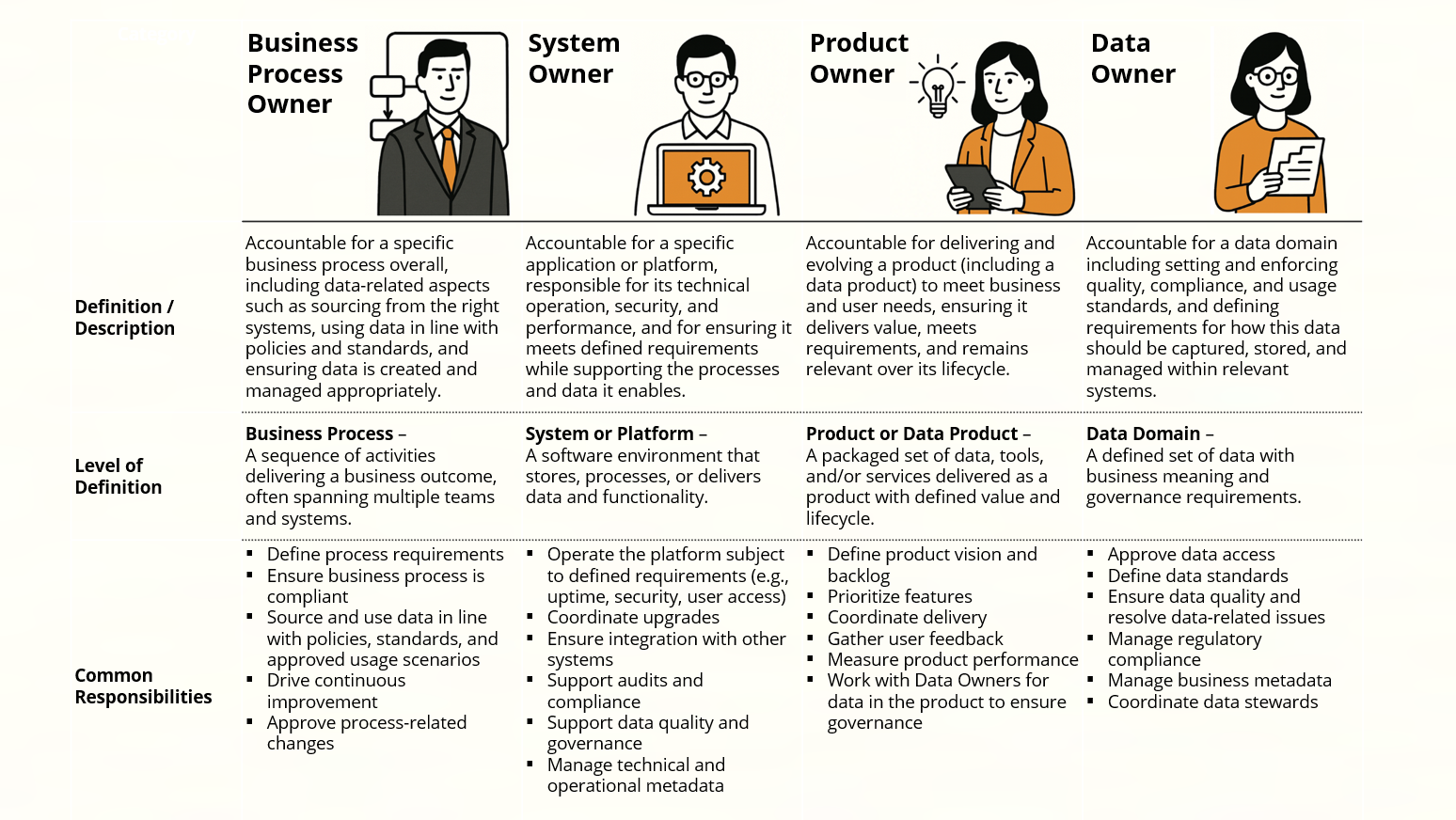
- Clear Roles and Responsibilities: The cornerstone of effective **Data Ownership** is the unambiguous definition of roles. Organizations should define explicit roles for data owners (accountable for the data’s overall lifecycle, quality, and compliance), data stewards (operational managers ensuring data quality and adherence to policies), and data custodians (technical teams managing storage and infrastructure). This clarity ensures that accountability is distributed appropriately across the data lifecycle.
- Robust Data Governance Frameworks: Implementing comprehensive **Data Governance Frameworks** is non-negotiable. These frameworks define the policies, standards, processes, and metrics for managing data assets. They should explicitly incorporate ownership assignments, data classification, security protocols, and usage guidelines. Leveraging a dedicated **Data Governance Platform** can automate many of these processes, from **Metadata Management** to **Policy Enforcement**, ensuring consistency and scalability.
- Leveraging Technology: Data Catalogs and Automated Governance Tools: Modern tools are indispensable. A **Data Catalog** serves as the central repository for all data assets, providing critical metadata that explicitly links datasets to their owners, stewards, and associated business glossaries. Automated governance tools can monitor data quality, enforce access controls (**Role-Based Access Control**), and track **Data Lineage**, significantly reducing manual effort and improving accuracy.
- Regular Audits and Reviews: Data environments are dynamic. Periodic audits and reviews of data ownership policies are essential to adapt to evolving business needs, technological changes, new data sources, and regulatory updates. These reviews should assess compliance, identify gaps, and ensure that ownership assignments remain relevant and effective. Continuous monitoring for data drift and compliance violations, especially for data feeding AI systems, should be integrated into these reviews.
- Foster a Data-Driven Culture: Beyond technology and processes, cultivating a data-driven culture is crucial. This involves educating employees about the importance of data, their roles in maintaining its quality and security, and the benefits of clear **Data Ownership**. Training, communication, and leadership buy-in are vital for embedding these practices throughout the organization.
The Strategic Advantage of Proactive Data Ownership: Building for the Future
Embracing proactive and robust **Data Ownership** practices is not merely about compliance or risk mitigation; it is about strategically positioning an organization for sustainable growth and long-term success in an increasingly data-driven world.
- Fostering Innovation and Trust: By establishing clear **Data Ownership**, organizations empower teams to innovate with data confidently, knowing its provenance, quality, and usage boundaries. This clarity removes uncertainty, accelerates data-driven initiatives, and fosters a culture of responsible experimentation. Simultaneously, transparent data practices build stronger trust with customers, partners, and stakeholders, reinforcing the organization’s reputation as a reliable and ethical data steward.
- Mitigating Future Risks: Proactive **Data Ownership** acts as a powerful preventative measure against potential security breaches, compliance failures, and reputational damage. By embedding accountability and clear guidelines into the data lifecycle, organizations can anticipate and address vulnerabilities before they escalate, safeguarding critical assets and minimizing costly disruptions. This includes anticipating **Data Drift** in ML models and proactively managing it through clear ownership of feature stores and training data.
- Unlocking New Business Opportunities: When organizations truly understand and control their data assets, they can identify novel ways to leverage information for strategic advantage. This might include developing new data products, enhancing existing services, personalizing customer experiences, optimizing operational efficiencies, or identifying untapped market opportunities. Clear ownership enables faster data monetization and more effective data-driven strategy formulation. This directly relates to the ability to effectively use **Data for AI** to drive new business value.
World2Data Verdict: Charting the Course for Accountable Data
In the intricate ecosystem of modern enterprise, clear and enforceable **Data Ownership** is no longer a luxury but an absolute necessity. World2Data.com asserts that organizations must view data ownership as a continuous, strategic imperative, integrating it deeply into their **Data Governance Platform** and overall **Data Management System**. The future of data-driven success, particularly for those heavily invested in AI and machine learning, hinges on a distributed yet accountable model of ownership. By meticulously defining roles, leveraging advanced **Data Catalogs** for transparency, embracing **Data Mesh** principles for domain autonomy, and committing to continuous auditing, enterprises can transform their data from a potential liability into their most powerful asset, ensuring ethical use, fostering innovation, and cementing their position as leaders in the data economy. Prioritizing **Data Ownership** today is the fundamental step towards building a resilient, intelligent, and ethically responsible organization poised for enduring prosperity.