


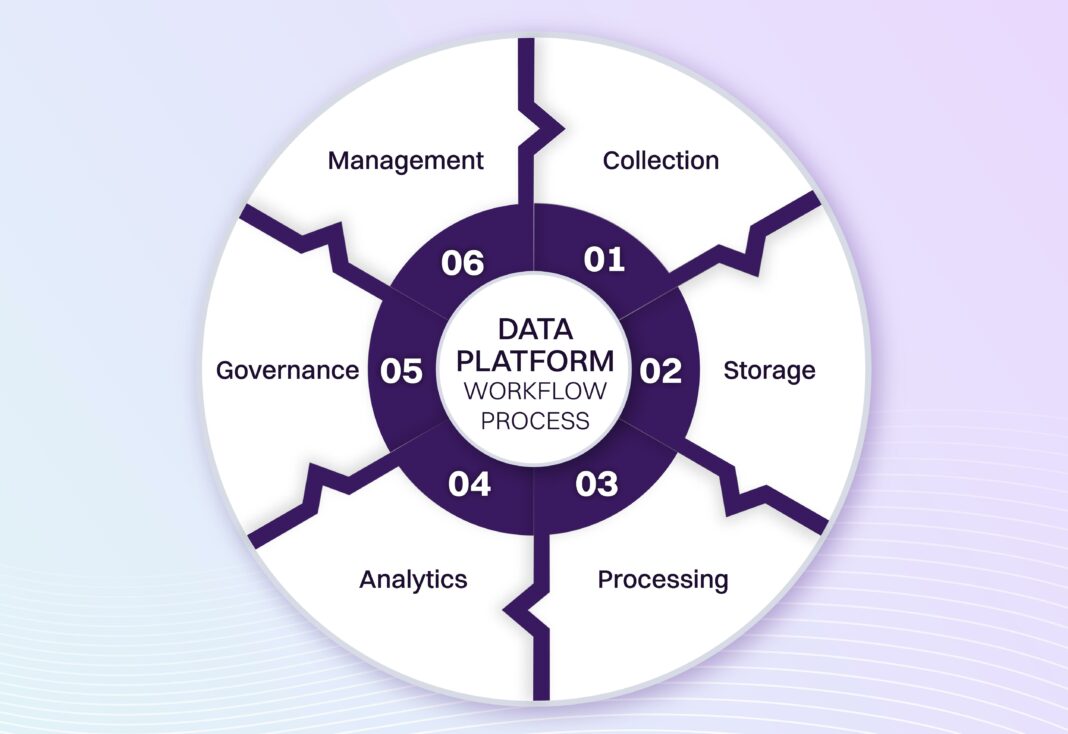
What Is a Data Platform? A Modern Overview for 2025: Unified Data Management & Analytics Platform
In the rapidly evolving digital landscape of 2025, understanding what constitutes a modern Data Platform is not just a technical inquiry but a strategic business imperative. This comprehensive article delves into the crucial evolution of how organizations manage, process, and extract immense value from their ever-growing datasets. Moving beyond traditional silos, today’s Data Platform stands as the unified backbone for data-driven innovation, ensuring consistency, accessibility, and actionable insights across an enterprise.
A sophisticated Data Platform today embraces Cloud-native, Serverless, and Distributed Architectures, often incorporating principles of Data Fabric/Mesh for enhanced agility. It offers Integrated Data Catalog, Automated Data Lineage, Role-Based Access Control, and advanced Metadata Management. Furthermore, built-in ML services facilitate seamless integration with major ML cloud platforms and robust support for MLOps. Prominent examples include Cloud-specific data platforms like AWS Lake House, Azure Synapse, and Google Cloud Data Platform, alongside Integrated Data Lakehouses such as Databricks, and specialized Data Warehouses combined with extensive ecosystems like Snowflake.
Introduction: The Imperative for a Modern Data Platform
The year 2025 marks a pivotal point where data is not merely an asset but the lifeblood of competitive advantage. Organizations are drowning in unprecedented volumes of information, ranging from operational transactions and customer interactions to sensor data and social media feeds. This deluge has rendered traditional, fragmented data management approaches obsolete. A modern Data Platform emerges as the essential solution, designed to unify, manage, process, and analyze diverse data types at scale, delivering timely and accurate insights critical for strategic decision-making.
The objective of this deep dive is to demystify the contemporary Data Platform, exploring its architectural underpinnings, core components, and the transformative impact it has on business operations and innovation. We will examine how these platforms have evolved to meet the demands of real-time analytics, machine learning, and artificial intelligence, setting the stage for a truly data-intelligent culture within enterprises worldwide.
Core Breakdown: Architecture, Components, and Value of a Modern Data Platform
A modern Data Platform is far more than a simple repository; it’s an intricate ecosystem engineered for end-to-end data lifecycle management. Its architecture is typically characterized by high scalability, elasticity, and resilience, predominantly leveraging cloud-native services.
Architectural Paradigms: Cloud-Native, Serverless, and Distributed Principles
At its heart, the modern Data Platform is built on Cloud-native, Serverless, and Distributed Architecture principles. Cloud-native ensures that platforms are designed to fully exploit the capabilities of cloud computing, offering unparalleled scalability, reliability, and cost efficiency. Serverless components abstract away infrastructure management, allowing teams to focus purely on data processing logic. Distributed architectures enable parallel processing of vast datasets, overcoming the limitations of single-node systems and facilitating real-time analytics.
The concept of Data Fabric/Mesh principles further enhances this architecture by promoting decentralized data ownership and access. A Data Fabric creates a unified, virtualized data layer across disparate sources, making data easily discoverable and accessible. A Data Mesh, conversely, advocates for data as a product, with domain-oriented teams owning and serving their data, fostering greater agility and quality.
Essential Components and Capabilities
The functionality of a sophisticated Data Platform is realized through several interconnected components:
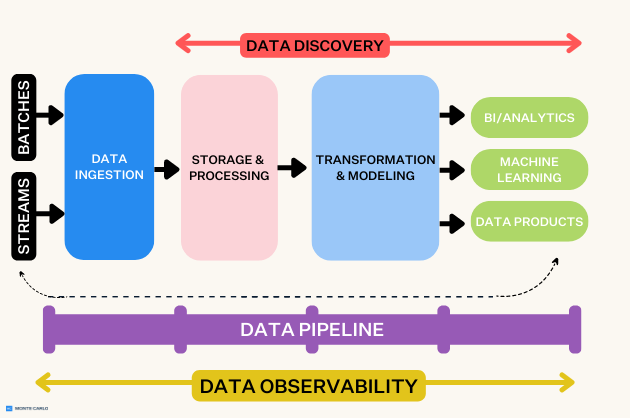
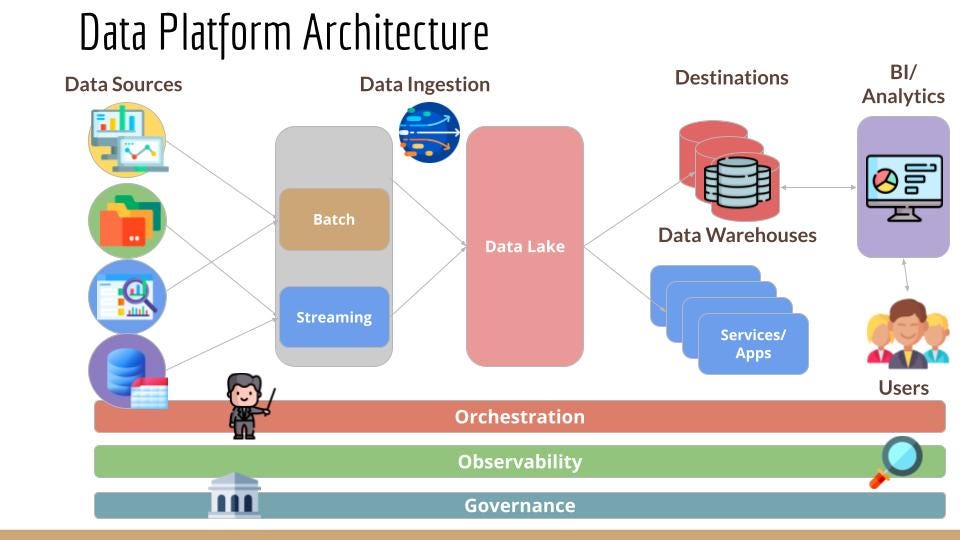
- Data Ingestion and Storage: Capable of ingesting structured, semi-structured, and unstructured data from various sources (databases, APIs, streaming services, IoT devices) in batch or real-time. Storage solutions often combine high-performance data warehouses with flexible data lakes, sometimes unified into an Integrated Data Lakehouse model (e.g., Databricks).
- Data Transformation and Governance: Tools for cleansing, transforming, and enriching raw data into valuable insights. Robust Metadata Management and Automated Data Lineage are crucial here, providing transparency into data origins, transformations, and usage.
- Integrated Data Catalog: A central registry that makes data assets discoverable, understandable, and accessible to authorized users. This component is vital for data democratization and preventing data silos.
- Role-Based Access Control (RBAC): Essential for security and compliance, RBAC ensures that data access is granted based on user roles and permissions, protecting sensitive information.
- Analytics and Machine Learning Services: Built-in analytics engines support SQL, NoSQL, and advanced analytical workloads. Modern platforms include Built-in ML services, offering tools for model training, deployment, and monitoring. They provide seamless integration with major ML cloud platforms and robust support for MLOps, streamlining the entire machine learning lifecycle.
- API-driven Access: Facilitating seamless integration with other business applications, BI tools, and custom solutions, making data easily consumable across the enterprise.
Examples of Modern Data Platforms in Action
The market offers a variety of powerful Data Platform solutions, often tailored or extensible for specific needs:
- Cloud-specific data platforms: AWS Lake House (combining S3, Redshift, Glue, Athena), Azure Synapse Analytics (unifying data warehousing, big data analytics, and data integration), and Google Cloud Data Platform (featuring BigQuery, Dataflow, Dataproc).
- Integrated Data Lakehouses: Databricks, which seamlessly blends the best features of data lakes and data warehouses, offering a unified platform for all data and AI workloads.
- Specialized Data Warehouses with Ecosystems: Snowflake, known for its scalable data warehousing capabilities, enhanced by a vast ecosystem of partners for data ingestion, transformation, and analytics.
Challenges/Barriers to Adoption
Despite their immense potential, implementing and managing a modern Data Platform comes with its own set of challenges:
- Data Governance and Quality: Ensuring consistent data quality, managing data privacy, and adhering to regulatory compliance across diverse and evolving datasets can be incredibly complex. Lack of clear governance frameworks can undermine the platform’s value.
- Integration Complexity: Integrating legacy systems and disparate data sources into a unified platform often presents significant technical hurdles and requires sophisticated ETL/ELT processes.
- Skill Gaps: The demand for data engineers, data scientists, and MLOps specialists with expertise in cloud-native technologies, distributed systems, and advanced analytics often outstrips supply.
- Cost Management: While cloud-native platforms offer elasticity, optimizing cloud resource consumption and managing costs effectively requires careful planning and monitoring.
- Organizational Silos: Overcoming organizational resistance to change and breaking down departmental data silos is crucial for successful platform adoption and fostering a data-driven culture.
Business Value and ROI
The strategic investment in a comprehensive Data Platform yields substantial returns:
- Enhanced Decision Making: By providing timely, accurate, and comprehensive insights, stakeholders can make more informed and proactive business decisions.
- Scalability for Growth: The elastic nature of cloud-native platforms allows businesses to effortlessly adapt to increasing data volumes and user demands without performance degradation, supporting future growth.
- Competitive Advantage: Enabling rapid innovation, faster product development cycles, and quicker responses to market shifts provides a significant edge over competitors.
- Operational Efficiency: Automating data pipelines, reducing manual data preparation, and streamlining analytics processes lead to greater operational efficiency and cost savings.
- Data Quality for AI: A well-governed platform ensures high-quality data, which is foundational for building reliable and accurate AI and ML models, accelerating time-to-value for AI initiatives.
Comparative Insight: Modern Data Platform vs. Traditional Models
To fully appreciate the significance of a modern Data Platform, it’s crucial to understand how it transcends its predecessors: the traditional data warehouse and the early iterations of data lakes.
Traditional Data Warehouses
Historically, data warehouses were the cornerstone of business intelligence. Designed for structured, historical data, they excelled at reporting and descriptive analytics. Key characteristics included:
- Schema-on-Write: Data was meticulously cleaned, transformed, and structured before ingestion, ensuring high data quality but limiting flexibility.
- Relational Databases: Primarily relied on relational database management systems (RDBMS), making them less suitable for unstructured data.
- Batch Processing: Focused on periodic batch updates, not geared for real-time insights.
- Limited Scalability: Scaling often involved expensive hardware upgrades and complex management.
While still valuable for specific use cases, traditional data warehouses struggle with the volume, velocity, and variety of modern data, and are not natively designed for advanced analytics or machine learning.
Traditional Data Lakes
Data lakes emerged to address the limitations of data warehouses, offering a cost-effective way to store vast amounts of raw, multi-structured data. Their characteristics included:
- Schema-on-Read: Data was stored in its raw format, with schema applied at the time of reading, offering immense flexibility.
- Cost-Effective Storage: Leveraging commodity hardware or cloud storage (e.g., S3), making it cheap to store petabytes of data.
- Support for Unstructured Data: Ideal for storing logs, images, videos, and other complex data types.
However, early data lakes often became “data swamps” due to a lack of governance, metadata, and quality control. Discovering and trusting data within a data lake could be a significant challenge, making it difficult for business users to derive value without extensive technical intervention.
The Modern Data Platform: A Convergence and Evolution
The modern Data Platform represents an evolution and convergence, synthesizing the strengths of both data warehouses and data lakes while introducing new capabilities:
- Unified Architecture: Blends the best of both worlds, often through an Integrated Data Lakehouse approach. It offers the flexibility and scalability of a data lake for raw data storage and complex data types, coupled with the data governance, performance, and SQL-analytics capabilities of a data warehouse.
- Real-time Processing: Built-in streaming capabilities allow for immediate data ingestion and processing, supporting real-time analytics and operational intelligence.
- AI and ML Integration: Designed from the ground up to support the entire machine learning lifecycle, from data preparation and feature engineering (often with a Feature Store) to model training, deployment (MLOps), and monitoring.
- Enhanced Governance and Metadata: Robust Data Catalog, Automated Data Lineage, and Metadata Management tools ensure data discoverability, quality, and compliance, addressing the “data swamp” problem of early data lakes.
- Semantic Layer: Many platforms now offer a semantic layer, abstracting technical complexities and providing a business-friendly view of data, empowering a wider range of users.
- Cost Efficiency and Elasticity: Leveraging Cloud-native, Serverless, and Distributed Architecture ensures that resources scale dynamically with demand, optimizing cost and performance.
In essence, while traditional systems were focused on specific data types or workloads, the modern Data Platform provides a holistic, integrated environment that supports all data personas (engineers, analysts, data scientists) and all data workloads (batch, streaming, analytical, AI/ML) on a single, scalable foundation.
World2Data Verdict: Embracing the Future of Data
The journey towards a truly data-driven enterprise in 2025 unequivocally hinges on the adoption and strategic utilization of a modern Data Platform. It is no longer sufficient to merely collect data; organizations must be equipped to unify, govern, analyze, and leverage it for intelligent automation and informed decision-making at speed and scale. The proliferation of AI and Machine Learning demands an underlying infrastructure that can reliably feed high-quality data into complex models, and the modern data platform is precisely that foundation.
World2Data.com advises organizations to embark on a phased implementation, prioritizing a Cloud-native, Serverless, Distributed Architecture that aligns with Data Fabric/Mesh principles. Focus intensely on establishing robust Data Governance, including an Integrated Data Catalog, Automated Data Lineage, and stringent Role-Based Access Control from day one. Invest in upskilling your teams and fostering a data-intelligent culture. By embracing an Integrated Data Lakehouse approach and leveraging the rich ecosystems of leading providers like AWS, Azure, Google Cloud, Databricks, and Snowflake, businesses will not only overcome current data challenges but also unlock unprecedented opportunities for innovation and sustained competitive advantage. The future is data-powered, and the modern Data Platform is your engine.