


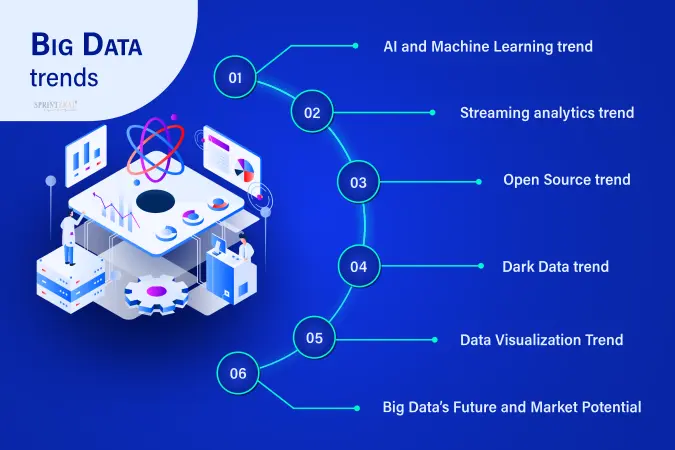
This Year’s Big Data Technology Trends: Navigating the Future of Information
The landscape of data management and analytics is in a perpetual state of evolution, driven by an unprecedented volume of information and the ever-increasing demand for actionable insights. This year’s Big Data Technology Trends are profoundly shaping how organizations harness information, pushing the boundaries of analytical capabilities and data governance. Understanding these transformative trends is not merely an academic exercise; it is essential for businesses seeking to maintain a competitive edge, unlock new value from vast datasets, and establish robust, future-proof data strategies.
From the architectural shifts towards Data Lakehouses and Data Fabrics to the integration of cutting-edge Generative AI and the imperative for real-time streaming analytics, the focus is squarely on creating more intelligent, efficient, and accessible data ecosystems. These advancements highlight a collective push towards advanced automation, sophisticated AI/ML integration, and a decentralized approach to data ownership, all aimed at democratizing data access and accelerating time-to-insight for every stakeholder.
Introduction: The Shifting Sands of Big Data
The relentless growth of data, stemming from IoT devices, social media, transactional systems, and more, has created a fertile ground for innovation in processing, storing, and analyzing information. This year, the Big Data Technology Trends are characterized by a strong emphasis on integration, automation, and intelligence. The objective is clear: move beyond mere data accumulation to proactive data utilization that directly fuels business growth and innovation. The primary keyword, “Big Data Technology Trends,” encapsulates this dynamic environment where traditional methods are being challenged and new paradigms are emerging to meet complex demands.
At the forefront of these shifts are architectural innovations like the Data Lakehouse and Data Fabric, which promise the best of both worlds – the flexibility of data lakes combined with the structured management of data warehouses. Core technologies are advancing rapidly, with Generative AI moving from experimental to integral, especially for natural language querying and data synthesis. Real-time streaming analytics is no longer a niche requirement but a mainstream necessity for immediate operational insights. Furthermore, data governance is being revolutionized by AI-driven Data Observability and Active Metadata Management, while MLOps Automation becomes crucial for scaling AI initiatives effectively. This convergence defines the current trajectory of Big Data.
Core Breakdown: Deep Dive into Emerging Big Data Technologies
The current wave of Big Data Technology Trends is defined by several interconnected advancements, each addressing specific challenges and opportunities within the data ecosystem. These trends are not isolated but rather form a cohesive strategy for maximizing data value.
The Ascent of Data Lakehouses and Data Fabric
This year sees the maturation and wider adoption of the Data Lakehouse architecture, which cleverly combines the low-cost storage and schema flexibility of a data lake with the ACID transactions, data governance, and performance of a data warehouse. This hybrid model simplifies the data stack, allowing organizations to run BI, SQL, and AI/ML workloads on the same data. Complementing this is the rise of the Data Fabric, an architectural concept that provides an integrated layer of data and analytics services over disparate data sources. It focuses on intelligent and automated data integration across various environments – on-premises, cloud, and edge – delivering a unified, consistent, and trusted view of data without physical centralization. These platform categories are pivotal in addressing the complexity of modern data landscapes.
Generative AI and MLOps Automation in Data Platforms
Generative AI is poised to be a game-changer across the entire data lifecycle. Beyond traditional predictive analytics, embedded Generative AI is enabling natural language querying, allowing business users to interact with complex datasets using plain English, democratizing access to insights. It also plays a role in data synthesis for model training, data augmentation, and even automated report generation. This integration into an AI Data Platform is critical for leveraging the full potential of large language models (LLMs) and other generative techniques. Hand-in-hand with this is the paramount importance of MLOps Automation. As AI/ML models become integral to operations, MLOps provides the framework and tools to manage the entire machine learning lifecycle – from data preparation and model training to deployment, monitoring, and governance – ensuring reliability, scalability, and reproducibility of AI solutions. This automation is crucial for tackling MLOps complexity and ensuring continuous value delivery from machine learning initiatives.
Real-time Streaming and Advanced Analytics
The demand for immediate insights has accelerated the adoption of Real-time Streaming Analytics. Low-latency data ingestion and processing are now critical for applications ranging from fraud detection and personalized customer experiences to dynamic supply chain optimization and IoT sensor monitoring. Technologies like Apache Kafka, Apache Flink, and cloud-native streaming services enable organizations to process data instantly as it arrives, moving beyond batch processing limitations. This facilitates streamlined operational insights, allowing businesses to react, optimize processes, and deliver dynamic customer experiences, gaining a significant competitive advantage by making decisions at the speed of business.
Data Mesh and Decentralized Governance
The Data Mesh paradigm continues to gain traction as a decentralized architectural and organizational approach. It advocates for domain-oriented data ownership, where cross-functional business domains manage their data products as first-class citizens, complete with their own APIs and clear contracts. This decentralized approach fosters accountability, improves data quality, and embeds expertise closer to the data source. Coupled with federated computational governance, it ensures compliance and interoperability across the mesh. Ultimately, this approach improves data accessibility for consumers, breaking down silos and fostering collaboration by making data easily discoverable, understandable, addressable, trustworthy, and secure.
Augmented Analytics and Data Storytelling
Augmented analytics, leveraging AI and Machine Learning, is transforming how users interact with and derive value from data. It automates data preparation, insight generation, and explanation, making sophisticated analysis accessible to a broader audience. Natural language generation for insights allows users to pose questions in plain language and receive narrative explanations, significantly democratizing analysis. Coupled with advanced visual data exploration tools, it empowers users to uncover patterns, identify anomalies, and communicate findings through compelling data storytelling, making complex insights understandable and actionable for decision-makers at all levels.
Challenges and Barriers to Adoption
Despite the immense potential of these Big Data Technology Trends, organizations face significant challenges in their adoption. One critical barrier is Data Drift, where the statistical properties of the target variable (or relationship between input variables and target variable) change over time, leading to degraded model performance. Managing data quality and consistency across distributed systems, especially in Data Fabric or Data Mesh architectures, demands robust strategies. The inherent MLOps Complexity in deploying, monitoring, and maintaining machine learning models at scale, often across diverse environments, can overwhelm teams lacking specialized skills. Furthermore, ensuring data privacy and compliance with evolving regulations (e.g., GDPR, CCPA) across vast, heterogeneous datasets remains a perennial concern. The shortage of skilled professionals in areas like data engineering, MLOps, and advanced analytics also poses a significant hurdle to effective implementation and innovation.
Business Value and ROI from Modern Data Platforms
Implementing these advanced Big Data Technology Trends yields substantial business value and a compelling return on investment (ROI). A key benefit is Faster Model Deployment and iteration, thanks to robust MLOps practices and integrated AI Data Platforms, enabling organizations to bring new AI-driven products and services to market more quickly. Improved Data Quality for AI, driven by AI-driven Data Observability and Active Metadata Management, directly translates to more accurate and reliable machine learning models, reducing costly errors and improving decision-making. Real-time insights lead to enhanced operational efficiency, better customer experiences through personalized services, and the ability to detect fraud or anomalies instantaneously. Ultimately, these capabilities empower businesses to achieve competitive advantage by identifying new revenue streams, optimizing resource allocation, and fostering a culture of data-driven innovation across the enterprise.

Comparative Insight: Evolving Beyond Traditional Paradigms
The current Big Data Technology Trends represent a significant departure from the traditional data management architectures that have dominated for decades. Historically, organizations relied heavily on centralized Data Warehouses for structured data analysis and, more recently, Data Lakes for storing vast quantities of raw, unstructured data. While effective for their specific purposes, these models often create silos, hinder agility, and struggle with the demands of modern AI and real-time processing.
The emergence of Data Lakehouses bridges the gap, offering the best of both worlds within a single, unified platform that supports both structured analytics and unstructured data processing, effectively challenging the strict separation of concerns that characterized previous approaches. The Data Fabric, on the other hand, moves beyond physical consolidation, providing a virtualized, intelligent layer that connects and governs data scattered across various sources, including legacy data warehouses, cloud data lakes, and operational databases. This contrasts sharply with the traditional approach where data movement and transformation were often manual, time-consuming, and resource-intensive.
Another crucial distinction lies in processing paradigms. Traditional systems often focused on Batch Processing, where data was collected over time and processed in large chunks. While still relevant for certain use cases, the shift towards Real-time Processing, driven by streaming analytics technologies, is a direct response to the need for immediate insights for operational decision-making. Furthermore, the “Main Competitors/Alternatives” are less about competing products and more about competing philosophies: the centralized control of a traditional Data Warehouse versus the decentralized, domain-driven agility of a Decentralized Data Mesh. While a centralized data warehouse offers simplicity in governance for some scenarios, the Data Mesh prioritizes scalability, autonomy, and data ownership, fostering faster innovation within individual business units but requiring sophisticated federated governance to maintain coherence and compliance. These comparisons highlight a fundamental pivot towards more flexible, intelligent, and autonomous data ecosystems.

World2Data Verdict: Charting the Future of Data Innovation
The confluence of this year’s Big Data Technology Trends paints a clear picture: the future of data platforms is intelligent, integrated, and autonomous. World2Data.com recommends that organizations strategically invest in hybrid data architectures like the Data Lakehouse and embrace the Data Fabric paradigm to unify their disparate data landscapes. Prioritize the integration of Generative AI for enhanced natural language querying and automated insight generation, coupled with robust MLOps automation to ensure AI models deliver continuous, measurable business value. Focus on building real-time data streaming capabilities to power instantaneous decision-making and leverage AI-driven Data Observability and Active Metadata Management to establish proactive data governance. The most successful enterprises will be those that not only adopt these technologies but also foster a culture of data literacy and decentralized data ownership, treating data as a product to empower every domain. This holistic approach will transform data from a mere resource into a powerful engine for sustained innovation and competitive differentiation.
The ongoing evolution of Big Data Technology Trends signifies a future where data is intelligently leveraged to drive every facet of an organization. These advancements highlight a collective push towards more intelligent, efficient, and accessible data ecosystems, continuously reshaping how we interact with and benefit from the vast digital landscape. The journey ahead demands agility, strategic investment, and a forward-thinking approach to data governance and utilization.