


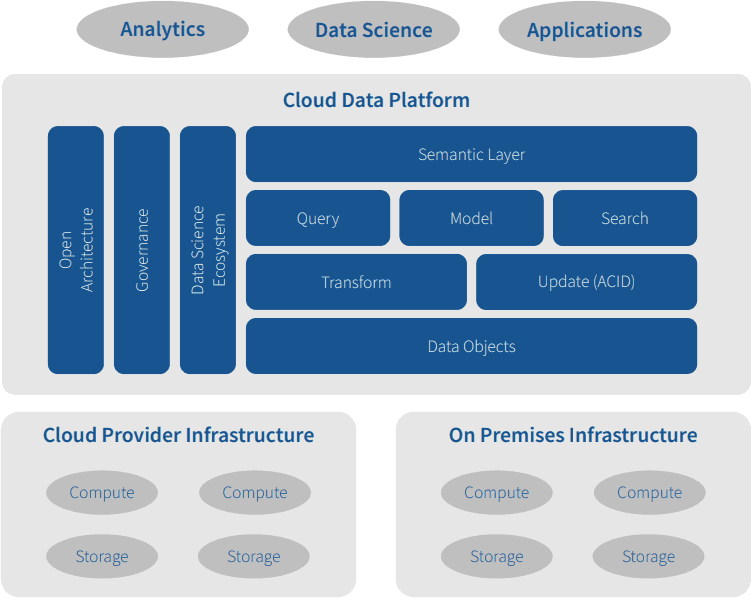
Cloud Data Platform: Why Enterprises Are Moving to the Cloud for Data Modernization
Platform Category: Integrated Cloud Data Platform Suite (encompassing Data Warehouses, Data Lakes, ETL, Analytics, and ML services)
Core Technology/Architecture: Managed Services, Elastic Scalability, Serverless Computing, Pay-as-you-go Model, Distributed Processing, Global Infrastructure
Key Data Governance Feature: Centralized Identity and Access Management (IAM), Data Encryption (at rest and in transit), Audit Logging, Compliance Certifications, Data Masking, Data Lineage
Primary AI/ML Integration: Integrated Machine Learning Services, API-driven ML tools, Scalable compute for ML workloads, Pre-built ML models and APIs, Connections to major ML frameworks
Main Competitors/Alternatives: On-premise Legacy Data Systems, Amazon Web Services (AWS), Microsoft Azure, Google Cloud Platform (GCP)
The strategic adoption of a Cloud Data Platform is no longer a luxury but a critical imperative for organizations aiming to harness their information effectively and gain a competitive edge in today’s data-intensive landscape. Enterprises across industries are increasingly recognizing that the agility, scalability, and cost-efficiency offered by cloud-based solutions are indispensable for modern data management. This deep dive explores the compelling reasons behind the widespread shift to the cloud, dissecting the architectural advantages, business value, and transformational impact of a robust Cloud Data Platform.
Introduction: The Irreversible Shift to the Cloud for Enterprise Data
The question of “Why Enterprises Are Moving to the Cloud” for their data infrastructure is pivotal for businesses navigating today’s increasingly complex and data-rich environment. Traditionally, organizations grappled with monolithic on-premise data systems that struggled to keep pace with exponential data growth, evolving analytics demands, and the need for global accessibility. The emergence of the Cloud Data Platform has provided a revolutionary answer to these challenges, offering a paradigm shift from CapEx-heavy, inflexible data centers to OpEx-friendly, elastic cloud environments. This article aims to provide a comprehensive analysis of the drivers, benefits, and strategic implications of adopting a Cloud Data Platform, underscoring its role in fostering innovation and ensuring future-readiness for enterprises globally.
Core Breakdown: Dissecting the Architecture and Advantages of a Cloud Data Platform
A modern Cloud Data Platform is not merely a collection of isolated services but an integrated suite designed to manage the entire data lifecycle, from ingestion and storage to processing, analysis, and machine learning. Its architecture typically leverages managed services, serverless computing, and distributed processing, providing a robust foundation for enterprise data strategies.
Unlocking Unprecedented Scalability and Flexibility
The ability to expand and contract data resources as needed is arguably the most compelling core benefit of a Cloud Data Platform. Enterprises constantly face fluctuating data volumes, characterized by unpredictable peaks and troughs. An on-premise infrastructure often requires over-provisioning to handle maximum potential loads, leading to significant idle capacity and wasted resources during off-peak times. In contrast, a Cloud Data Platform offers truly elastic capacity, allowing organizations to dynamically scale storage and compute resources up or down in minutes, or even seconds, to meet demand without manual intervention. This on-demand resource provisioning ensures optimal performance during critical periods, such as year-end reporting or marketing campaigns, while simultaneously driving substantial cost savings during quieter periods. This inherent flexibility is crucial for businesses operating in dynamic markets, enabling them to adapt swiftly to changing business requirements and market conditions without prohibitive upfront investments.
Driving Significant Cost Efficiency and Optimized Resource Management
Moving to a Cloud Data Platform fundamentally alters the cost structure of data management, transitioning from a capital expenditure (CapEx) model to an operational expenditure (OpEx) model. This shift eliminates the need for large capital outlays on hardware procurement, data center maintenance, power, cooling, and the specialized IT personnel required to manage on-premise solutions. Cloud environments operate on a consumption-based, “pay-as-you-go” model, where companies only pay for the storage and compute resources they actually consume. This precise cost allocation and the ability to spin up and tear down resources on demand drastically reduce the Total Cost of Ownership (TCO). Furthermore, the highly optimized infrastructure of leading cloud providers often delivers better performance per dollar than what most individual enterprises can achieve on their own, further enhancing efficiency and ROI. Enterprises can reallocate saved capital and operational budgets towards innovation and core business activities, rather than infrastructure upkeep.
Enhancing Data Accessibility and Fostering Collaboration
A unified approach to data within a Cloud Data Platform inherently fosters better teamwork, accelerates insight generation, and democratizes data access. By creating centralized data hubs, all enterprise data—whether structured, semi-structured, or unstructured—is stored in a single, accessible, and often highly organized location. This breaks down departmental and geographical data silos, providing a consistent, 360-degree view of the business for all authorized users. Empowering distributed teams is another critical advantage; employees across different geographies, time zones, and departments can securely access, analyze, and collaborate on data projects in real-time. This enhanced collaboration improves productivity, streamlines workflows, and accelerates the development of data-driven products and services, fostering a culture of innovation across the organization.
Boosting Performance and Accelerating Innovation with Advanced Analytics
The advanced capabilities embedded within Cloud Data Platform solutions enable superior processing power for complex queries and massive datasets. Leveraging vast computational resources, including specialized hardware like GPUs for machine learning, cloud platforms can execute data transformations, analytical workloads, and real-time processing much faster than traditional systems. This translates to quicker insights and more responsive applications. Crucially, the cloud provides native integration with powerful AI and machine learning (ML) tools, services, and pre-built models. This seamless integration allows businesses to quickly operationalize advanced analytics, predictive modeling, and prescriptive insights without extensive setup or specialized infrastructure. Organizations can leverage services for natural language processing, computer vision, recommendation engines, and more, accelerating their journey towards becoming AI-driven enterprises and gaining a significant competitive edge.
Ensuring Robust Security and Compliance
For many enterprises, security remains a primary concern when considering cloud migration. However, leading Cloud Data Platform providers invest billions in enterprise-grade data protection, often surpassing the security capabilities that individual enterprises can maintain. These platforms offer multi-layered security frameworks, including comprehensive identity and access management (IAM), data encryption at rest and in transit, advanced threat detection, continuous monitoring, and robust disaster recovery mechanisms. Furthermore, cloud providers design their services to comply with a vast array of global and industry-specific regulations and certifications (e.g., GDPR, HIPAA, ISO 27001, SOC 2). This simplifies the path to data governance and compliance for businesses, allowing them to confidently store and process sensitive data while meeting stringent regulatory standards and mitigating risks associated with data breaches and non-compliance.
Challenges and Barriers to Cloud Data Platform Adoption
While the benefits of a Cloud Data Platform are undeniable, the journey to the cloud is not without its hurdles. Enterprises often encounter significant challenges that require careful planning and strategic execution. One major concern is Vendor Lock-in, where reliance on a specific cloud provider’s proprietary services can make it difficult and costly to migrate data or applications to another provider in the future. This necessitates a multi-cloud strategy or careful selection of services that adhere to open standards. Another significant barrier is the Complexity of Migration itself. Moving large volumes of existing data and legacy applications from on-premise systems to the cloud can be a resource-intensive and time-consuming process, fraught with potential data integrity issues and downtime risks. Proper migration strategies, including lift-and-shift, re-platforming, and refactoring, must be carefully evaluated and implemented.
Cost Management is another critical aspect. While the pay-as-you-go model offers efficiency, without vigilant monitoring and optimization, cloud costs can quickly spiral out of control. Enterprises need robust cost management tools, budgeting, and FinOps practices to ensure they only pay for what’s truly needed. Furthermore, maintaining stringent Data Governance and Compliance in a distributed cloud environment presents its own set of challenges. Data sovereignty, privacy regulations (like GDPR and CCPA), and internal governance policies require careful configuration and continuous oversight across diverse cloud services and global regions. Finally, a significant Skill Gap within an organization can impede successful adoption. The need for new skill sets in cloud architecture, DevOps, security, and specific cloud provider technologies often necessitates substantial investment in training or hiring new talent, which can be a slow and expensive process.
Business Value and Return on Investment (ROI) of a Cloud Data Platform
Despite the challenges, the long-term business value and ROI delivered by a Cloud Data Platform are compelling. Enterprises experience a significant boost in Agility and Responsiveness, allowing them to quickly launch new products, services, and analytical capabilities. This speed translates into a faster time-to-market and an enhanced ability to respond to competitive pressures. The integration of AI/ML services directly contributes to a Faster Time-to-Insight, as data scientists and analysts can leverage powerful tools without infrastructure bottlenecks, leading to more accurate predictions and prescriptive actions. The shift to an OpEx model and the optimization of resource utilization result in a demonstrably Reduced Total Cost of Ownership (TCO) over time, freeing up capital for strategic initiatives rather than infrastructure maintenance.
Crucially, a Cloud Data Platform empowers organizations with Improved Decision Making by providing access to comprehensive, high-quality, and real-time data. This data-driven culture fosters a deeper understanding of customer behavior, operational efficiencies, and market trends, leading to more informed strategic decisions. Ultimately, this leads to a tangible Competitive Advantage. Businesses that effectively leverage their cloud data assets can innovate faster, personalize customer experiences more effectively, and optimize their operations to a degree unreachable with legacy systems. The ability to easily experiment with new technologies and services, such as advanced analytics and machine learning, also enables continuous Innovation Enablement, positioning the enterprise for sustained growth and market leadership in the digital era.
.webp)
Comparative Insight: Cloud Data Platform vs. Traditional Data Lake/Data Warehouse
To fully appreciate the transformative power of a Cloud Data Platform, it’s essential to compare it with its predecessors: the traditional on-premise Data Lake and Data Warehouse. While these traditional systems served their purpose for decades, they face inherent limitations in today’s fast-paced, data-intensive world.
Traditional Data Warehouse
- Architecture: Primarily designed for structured, relational data, optimized for reporting and business intelligence (BI) on historical data. Typically uses a star or snowflake schema.
- Scalability: Limited, often requiring significant upfront hardware investment and complex vertical or horizontal scaling, which is time-consuming and expensive.
- Flexibility: Less flexible for unstructured or semi-structured data; schema-on-write approach can be rigid.
- Cost Model: High upfront capital expenditure for hardware, software licenses, and ongoing maintenance.
- Maintenance: Requires dedicated IT staff for infrastructure management, patching, upgrades, and disaster recovery.
- Performance: Excellent for well-defined, structured queries; can struggle with large-scale ad-hoc analytics or machine learning workloads.
Traditional Data Lake
- Architecture: Stores raw, multi-structured data (structured, semi-structured, unstructured) in its native format, often using technologies like Hadoop Distributed File System (HDFS). Schema-on-read provides flexibility.
- Scalability: More scalable than a traditional data warehouse for data volume, but scaling compute resources can still be complex and resource-intensive to manage.
- Flexibility: High flexibility for diverse data types, making it suitable for big data analytics and data science exploration.
- Cost Model: Lower storage costs than data warehouses but still incurs significant operational costs for cluster management, software licensing, and specialized talent.
- Maintenance: Requires highly specialized skills for managing complex distributed systems, ensuring data quality, and maintaining security.
- Performance: Can be slow for complex queries without extensive optimization; processing frameworks (e.g., Spark) are needed, adding complexity.
Modern Cloud Data Platform
- Architecture: Unifies capabilities of data warehouses and data lakes, often combining object storage for raw data (like a data lake) with highly optimized analytical databases (like a data warehouse), and integrating stream processing, ETL, and AI/ML services. It embraces managed, serverless, and elastic services.
- Scalability: Nearly infinite and on-demand scalability for both storage and compute resources, allowing independent scaling. Achieved automatically and transparently, leading to optimal performance and cost.
- Flexibility: Handles all data types with ease, supporting schema-on-read for exploration and schema-on-write for curated data. Adapts rapidly to new data sources and use cases.
- Cost Model: Pay-as-you-go, consumption-based model, transforming CapEx into OpEx. Offers significant cost optimization potential through efficient resource utilization.
- Maintenance: Vastly reduced operational overhead as cloud providers manage infrastructure, patching, upgrades, and security. Enterprises focus on data and analytics, not IT operations.
- Performance: Delivers high performance for diverse workloads, from traditional BI to real-time analytics and complex machine learning training, leveraging highly optimized cloud-native engines and specialized hardware.
- AI/ML Integration: Deep native integration with advanced AI/ML services, tools, and platforms, accelerating the development and deployment of intelligent applications.
The distinction is clear: while traditional systems are bound by physical infrastructure limitations and high operational overhead, a Cloud Data Platform offers unparalleled agility, cost-effectiveness, and a fully integrated ecosystem for modern data management and advanced analytics. It collapses the boundaries between data lakes and data warehouses, creating a unified fabric where data can be stored, processed, and analyzed with unprecedented efficiency and scale, paving the way for true data modernization.

World2Data Verdict: The Indispensable Future of Enterprise Data
The verdict from World2Data.com is unequivocal: the migration to a Cloud Data Platform is not merely a technological upgrade but a fundamental, irreversible shift towards a more agile, cost-effective, insightful, and resilient future for enterprise data. For any organization aiming to remain competitive, innovate rapidly, and derive maximum value from its proliferating data assets, adopting a comprehensive Cloud Data Platform is no longer optional but an essential strategic imperative. We predict that within the next five years, the vast majority of enterprise data will reside and be processed within cloud-native environments, driven by the continuous innovation of cloud providers and the ever-increasing demand for real-time analytics and AI/ML capabilities. Enterprises must prioritize this transformation, focusing on a phased migration strategy, robust cloud governance, and investing in new skill sets to fully leverage the power of the cloud. Those who embrace this transformation strategically will be best positioned to unlock unparalleled insights, accelerate their digital transformation journey, and secure their place as leaders in the data-driven economy.