


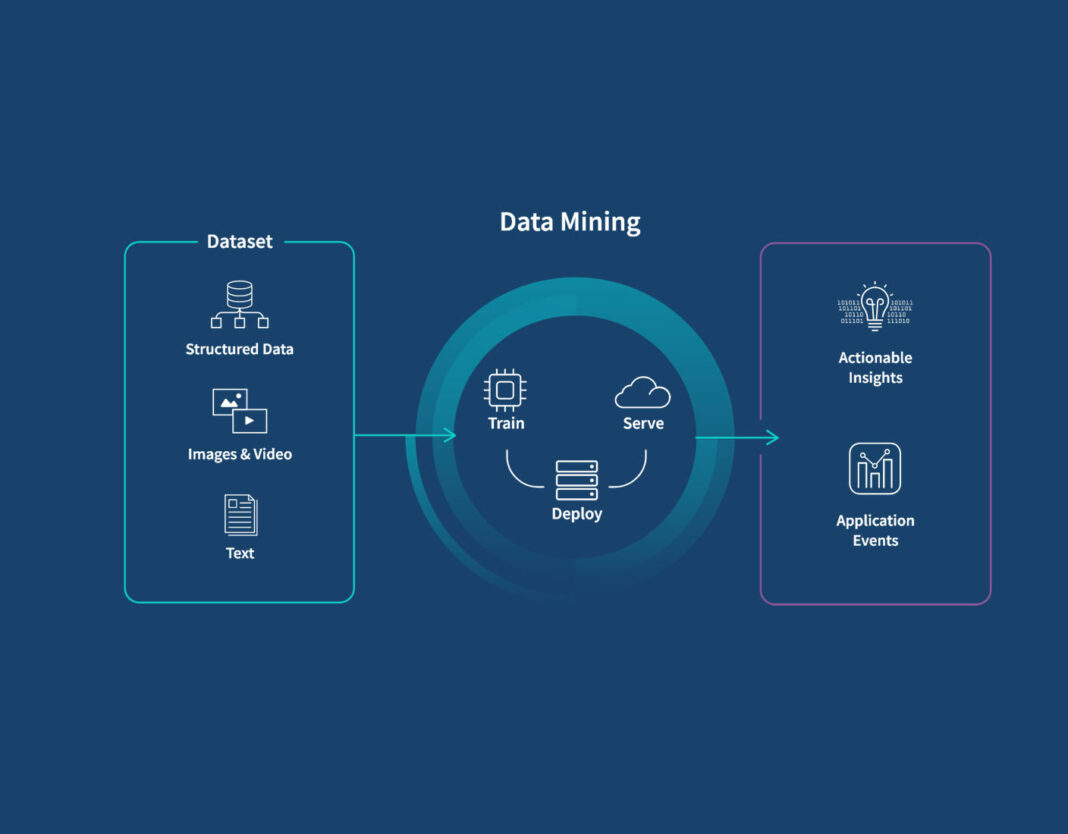
Data Mining: Unearthing Hidden Patterns in Large Datasets for Strategic Insights
Platform Category: Data Science and Analytics Platform
Core Technology/Architecture: Machine Learning Algorithms (classification, clustering, regression), Statistical Modeling
Key Data Governance Feature: Data Quality Management, Data Privacy and Anonymization
Primary AI/ML Integration: Utilizes and applies various machine learning algorithms for pattern discovery and predictive modeling
Main Competitors/Alternatives: SAS, IBM SPSS Modeler, R and Python (with ML libraries), RapidMiner, KNIME
In today’s hyper-connected world, organizations are drowning in data, yet often starved for actionable insights. Data Mining emerges as the beacon in this vast ocean, a sophisticated process dedicated to sifting through immense datasets to discover the subtle yet significant patterns, trends, and correlations that remain invisible to the naked eye. This transformative discipline converts raw, often noisy, data into valuable intelligence, empowering businesses to make smarter, data-driven decisions across myriad sectors, from finance to healthcare and retail.
Introduction: The Imperative of Pattern Discovery in the Data Age
The sheer volume and velocity of data generated daily present both an unprecedented challenge and an unparalleled opportunity. Traditional reporting and business intelligence tools, while essential for understanding what has happened, often fall short when it comes to predicting future outcomes or uncovering root causes hidden deep within the data fabric. This is precisely where Data Mining steps in. It’s not merely about collecting and storing data, but about actively exploring it, extracting meaningful knowledge, and enabling organizations to move beyond descriptive analytics to predictive and prescriptive models.
The objective of this article is to provide a deep dive into the technical intricacies, practical applications, and strategic importance of Data Mining. We will explore its core components, methodologies, and the challenges associated with its implementation, ultimately demonstrating its undeniable value proposition in an increasingly data-centric operational landscape. Understanding Data Mining is no longer a luxury but a fundamental requirement for competitive advantage and innovation.
Core Breakdown: Architecture and Methodologies of Data Mining
At its heart, Data Mining is an interdisciplinary field that draws heavily from statistics, artificial intelligence, machine learning, database systems, and information theory. The process typically involves several key stages, forming a robust pipeline for knowledge discovery:
- Data Preprocessing: This crucial initial phase involves data cleaning (handling missing values, noisy data), data integration (combining data from multiple sources), data transformation (normalization, aggregation), and data reduction (feature selection, dimensionality reduction). High-quality input data is paramount for generating reliable patterns.
- Data Mining Engine: This is where various algorithms are applied to uncover patterns. These algorithms fall into several categories:
- Classification: Assigns items in a collection to target categories or classes. Examples include decision trees, Naive Bayes, Support Vector Machines (SVMs), and neural networks. Used for fraud detection, credit scoring, or customer churn prediction.
- Clustering: Groups a set of objects in such a way that objects in the same group (a cluster) are more similar to each other than to those in other groups. Algorithms like K-Means, hierarchical clustering, and DBSCAN are common. Useful for customer segmentation or anomaly detection.
- Association Rule Mining: Discovers interesting relationships or associations among a large set of data items. The classic “market basket analysis” (e.g., customers who buy bread often buy milk) is a prime example, often using the Apriori algorithm.
- Regression: Models the relationship between a dependent variable and one or more independent variables. Used for forecasting continuous values, such as sales predictions, stock prices, or house prices, employing techniques like linear regression, logistic regression, or random forests.
- Anomaly Detection: Identifies unusual patterns that do not conform to expected behavior. Critical for cybersecurity, fraud detection, and system health monitoring.
- Pattern Evaluation: Once patterns are generated, they must be evaluated for their interestingness and validity. This often involves statistical measures, visualization techniques, and domain expert review to ensure patterns are novel, useful, and understandable.
- Knowledge Representation: The discovered patterns are then presented to the user in an understandable and actionable format, often through dashboards, reports, or automated alerts.
Challenges and Barriers to Effective Data Mining Adoption
Despite its immense potential, implementing and maintaining effective Data Mining initiatives comes with several significant challenges:
- Data Quality Issues: The “garbage in, garbage out” principle holds true. Inconsistent, incomplete, or noisy data can lead to misleading patterns and inaccurate predictions, undermining the entire effort. Robust data quality management strategies are essential.
- Scalability: As datasets grow into petabytes or even exabytes, traditional Data Mining algorithms can become computationally intensive and slow. Distributed computing frameworks like Apache Spark and advanced database technologies are often required to handle this scale.
- Model Interpretability and Explainability: Many powerful machine learning algorithms, particularly deep neural networks, operate as “black boxes,” making it difficult to understand why a particular prediction or classification was made. This lack of interpretability can be a significant barrier in regulated industries or where trust and transparency are critical.
- Data Privacy and Ethical Concerns: Mining large datasets, especially those containing personal information, raises serious ethical and privacy concerns. Ensuring compliance with regulations like GDPR and CCPA, implementing data anonymization techniques, and avoiding algorithmic bias are paramount.
- Skill Gap: A shortage of skilled data scientists, statisticians, and machine learning engineers capable of designing, implementing, and interpreting complex Data Mining models remains a substantial barrier for many organizations.
- Data Drift and Model Maintenance: Real-world data distributions can change over time (data drift), causing previously accurate models to become obsolete. Continuous monitoring, retraining, and redeploying models are essential for sustained accuracy, often managed through MLOps practices.
Business Value and Return on Investment (ROI) of Data Mining
The strategic application of Data Mining offers a compelling ROI across virtually every industry:
- Enhanced Decision-Making: By providing predictive insights, Data Mining allows businesses to move from reactive to proactive strategies, making more informed decisions regarding everything from product development to market entry.
- Customer Centricity: It enables deep understanding of customer behavior, preferences, and segmentation, leading to highly personalized marketing campaigns, improved customer satisfaction, and increased customer lifetime value.
- Fraud Detection and Risk Management: In finance and insurance, Data Mining algorithms are adept at identifying anomalous transactions or patterns indicative of fraudulent activity or high credit risk, saving billions of dollars annually.
- Operational Efficiency and Cost Reduction: By optimizing supply chains, predicting equipment failures (predictive maintenance), and streamlining processes, organizations can significantly reduce operational costs and improve efficiency.
- New Product Development and Market Opportunities: Uncovering unmet needs, emerging trends, or correlation between product features and customer satisfaction can drive innovation and identify lucrative market niches.
- Improved Healthcare Outcomes: From predicting disease outbreaks to personalizing treatment plans and analyzing drug efficacy, Data Mining is revolutionizing medical research and patient care.
:max_bytes(150000):strip_icc()/data-mining-49e2707e28c647ae95ada2852bfff11d.jpg)
Comparative Insight: Data Mining vs. Traditional Data Lake/Data Warehouse
While often discussed in conjunction, Data Mining, Data Lakes, and Data Warehouses serve distinct yet complementary roles within an organization’s data ecosystem. Understanding these differences is crucial for architecting effective data strategies.
- Data Warehouses: These are traditionally structured repositories designed for reporting and analytical purposes, typically storing historical data from various operational systems. Data is cleaned, transformed, and loaded (ETL) into a predefined schema, optimized for fast queries and business intelligence reports. They excel at answering “what happened?” based on structured, quality-controlled data.
- Data Lakes: In contrast, Data Lakes store raw, unstructured, semi-structured, and structured data at scale, often without a predefined schema. They are ideal for storing vast amounts of diverse data for future analytical needs, allowing for schema-on-read flexibility. Data Lakes are excellent for capturing everything and serving as a raw material source for various advanced analytics, including Data Mining.
- Data Mining: Neither a storage solution nor a reporting tool in itself, Data Mining is an analytical process that *operates on* the data residing in Data Warehouses or, more commonly and effectively, Data Lakes. It goes beyond descriptive reporting to discover hidden patterns, build predictive models, and generate hypotheses. While a Data Warehouse provides organized data for straightforward queries, Data Mining uses sophisticated algorithms to extract deeper, often non-obvious, insights from that data or the more varied and raw data in a Data Lake.
In essence, a Data Warehouse provides the organized foundation for routine business intelligence, and a Data Lake offers the raw, comprehensive input for exploratory and advanced analytics. Data Mining then acts as the intellectual engine that extracts actionable intelligence from these repositories, transforming stored information into predictive power and strategic advantage. They are not alternatives but integral parts of a holistic data strategy, with Data Mining leveraging the capabilities of both to deliver advanced insights.

World2Data Verdict: The Future is in Intelligent Pattern Recognition
The accelerating pace of data generation guarantees that Data Mining will not only remain relevant but will become an even more indispensable capability for organizations globally. World2Data believes that the true competitive edge in the coming decade will belong to entities that master the art and science of intelligent pattern recognition. Future advancements in Data Mining will likely focus on real-time processing, enhanced explainable AI (XAI) for ‘black box’ models, robust privacy-preserving techniques (like federated learning), and the seamless integration of unstructured data (text, images, video) into advanced analytical workflows. Organizations must invest strategically in data infrastructure, skilled personnel, and ethical governance frameworks to fully harness the power of Data Mining. For those prepared to navigate its complexities, the promise of transforming raw data into unparalleled strategic foresight is well within reach.