ProfileIQ Raises Bridge Round to Score the Credit Invisible
Credit Intelligence from Social Data. ProfileIQ transforms unstructured social data into reliable credit scores — enabling lenders to assess thin-file customers with up to 85% accuracy, where traditional bureaus see nothing.
ProfileIQ Closes Bridge Round with US Private Fund: AI Credit Scoring from Social Data for Thin-File Customers
Platform Overview:
- Platform Category: AI Credit Scoring and Alternative Data API Platforms
- Core Technology/Architecture: Unstructured Social Data Processing, Explainable Machine Learning Models, REST API, Batch Processing, Webhooks
- Key Data Governance Feature: Consent-Based Data Collection, Model Bias Controls, Decision Auditability, SOC 2 / ISO 27001, Data Processing Agreement (DPA)
- Primary AI/ML Integration: Real-time Scoring via API, AI Enrichment of Images, Activity Patterns and Network Signals, Outputs Including Score, Risk Tier and Confidence Level
- Main Competitors/Alternatives: Traditional Credit Bureau Scores, Bank Transaction Data Scoring, Telco Data Scoring, Manual Underwriting
- Funding Update: Bridge round, amount $500.000
Introduction: The Data Gap in Credit Scoring
Conventional credit scoring relies on borrowing and repayment history. For consumers who are new to credit or have never held a bank account, these systems simply have nothing to evaluate. Lenders are left facing a familiar dilemma: decline thin-file applicants and forgo revenue, or approve them without sufficient evidence and absorb higher default rates. This is the gap that alternative credit scoring is designed to close. Among alternative data sources, social data is rich in signal but difficult to use, as most of it is unstructured. This article explores how ProfileIQ approaches that challenge and why its latest bridge round deserves attention.Core Breakdown: The Bridge Round and ProfileIQ's Technology
A bridge round is an interim financing, typically structured as a convertible note or SAFE, that extends a startup's runway and helps it reach specific milestones ahead of its next priced round. Compared with a full Series round, a bridge is usually faster, involves less process, and leans on investors who already understand the business. ProfileIQ's decision to raise a bridge from a US private fund suggests that investors continue to back the thesis of social data as a credit signal, and that the company is prioritizing integrations and commercialization before pursuing a larger valuation event.Architectural Deep Dive: From Social Data to Credit Score
The ProfileIQ platform operates as a four-step, fully automated pipeline, from data ingestion to an output that is ready for a lender's decisioning system:- Data Input: The applicant grants consent, and social identifiers are securely submitted through the API or dashboard.
- AI Enrichment: The AI engine processes unstructured data, including images, activity patterns and network signals, across more than six sources.
- Scoring Model: An explainable ML model generates a composite credit score, risk tier and confidence level, with the auditability required for regulatory compliance.
- API Output: The score, risk tier, special flags and confidence level are delivered via REST API, batch processing or webhook.
Accuracy and Methodology: How Performance Is Validated
ProfileIQ reports predictive accuracy of up to 85%, measured on an independent validation dataset using AUC-ROC benchmarking against traditional bureau scores on the same cohort. The company cites two further layers of validation:- Out-of-Time Validation: Backtesting across multiple periods to confirm stability over time.
- Explainable and Auditable Model: Model governance that includes bias controls and decision-level traceability.
Data Governance and Compliance for Social Data Scoring
Social data is inherently sensitive, which makes governance and compliance a prerequisite for any alternative scoring solution. Key components include:- Consent-Based Data Collection: Data is collected only with the user's permission.
- Explainable AI: Supports regulatory requirements to explain why credit was approved or declined.
- Bias Controls and Auditability: Reduces the risk of indirect discrimination and creates an audit trail for every decision.
- Security and Compliance Documentation: The company references SOC 2 / ISO 27001 and a Data Processing Agreement (DPA) on its Trust pages.
Challenges and Barriers to Adoption
Despite its potential, credit scoring from social data faces several hurdles:- Privacy and Consent Management: Each market has its own legal framework for personal data, requiring rigorous consent processes.
- Algorithmic Bias: Social signals can reflect cultural or demographic differences, so continuous monitoring and recalibration are essential.
- Regulatory Acceptance: Regulators' views on alternative data in credit decisions vary from region to region.
- Signal Stability: Online behavior changes quickly, so models must be retrained and revalidated on a regular basis.
- Data Source Dependency: Changes to third-party platform API policies can affect the quality of input data.
- Independent Validation: Current performance figures are company-reported, and broader deployment will call for further independent verification.
Business Value and ROI of AI Credit Scoring
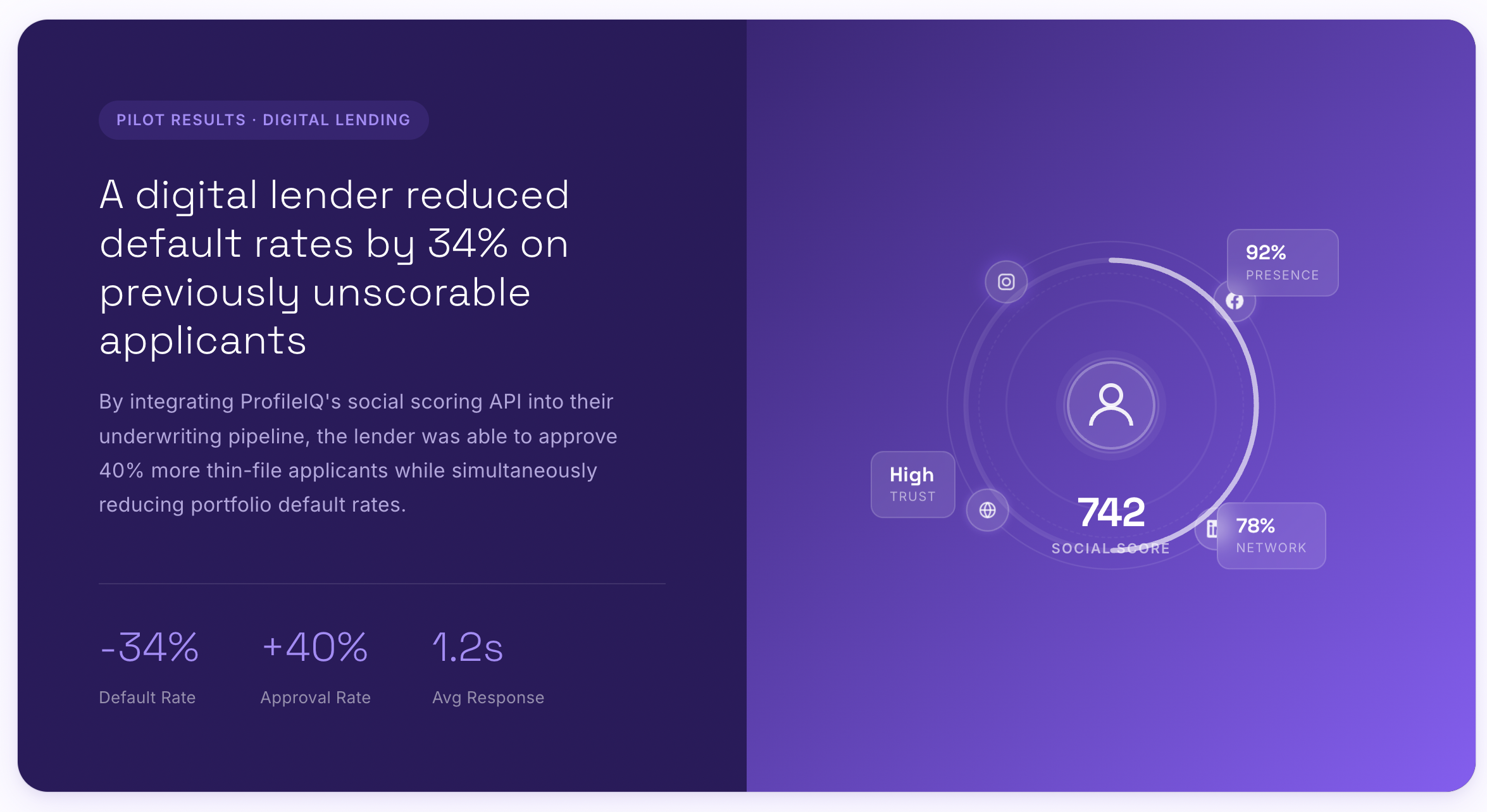
ProfileIQ targets four customer segments: fintech and digital lending, traditional banking (as a complement to bureau data), insurance, and BNPL and e-commerce. In a pilot with a digital lender, the company reported the following results:- Lower Default Rates: A 34% reduction in default rates among previously unscorable applicants.
- Higher Approval Rates: A 40% increase in approvals for thin-file applicants.
- Real-time Decisioning: An average response time of 1.2 seconds, suited to instant approval flows.
- Expanded Addressable Market: Access to customer segments that bureau data cannot reach.
- Data Monetization Ecosystem: Social data becomes a commercial data product delivered via API to partners such as Erebor, Octane, Apollo, Seamless, TurboFlow, Caplight, MetaComp and Finalis.
Comparative Insight: ProfileIQ vs. Traditional Credit Scoring
The differences become clearer when ProfileIQ is set against conventional approaches:- Traditional Credit Bureau Scores: Effective for borrowers with an established credit history, but offer no coverage for thin-file and new-to-credit customers. ProfileIQ can score anyone with a social footprint who consents to share it.
- Bank Transaction Data Scoring: Depends on the customer already holding an account with meaningful activity. ProfileIQ does not require banking history.
- Telco Data Scoring: Relies on carrier partnerships and market coverage. ProfileIQ provides an independent layer of signal through a single API.
- Manual Underwriting: Slow, labor-intensive and difficult to scale. ProfileIQ returns results in under two seconds and supports batch processing.
World2Data Verdict: A Bridge Round as a Test for Social Data Credit Scoring
A bridge round will not reshape the market overnight, but it does show that the case for lending to the credit invisible continues to attract private capital in the United States. World2Data.com believes ProfileIQ's long-term value will hinge on three factors: independent validation of its published accuracy, its ability to meet regulatory requirements in new markets, and its success in converting pilot results into large-scale commercial deployments. For lenders looking to expand into the thin-file segment, it is a solution worth including in a controlled evaluation. Learn more or request a demo at profileiq.net.
World2Data Editorial Desk
An authoritative global newsroom and national data intelligence platform.